Let the AI ​​Coding Wars Begin!

The big news this week was a call from tech luminaries to pause development and deployment of AI models more advanced than OpenAI’s GTP-4—the stunningly capable language algorithm behind ChatGPT—until risks including job displacement and misinformation can be better understood.

Even if OpenAI, Google, Microsoft, and other tech heavyweights were to stop what they’re doing—and they’re not going to stop what they’re doing—the AI ​​models that have already been developed are likely to have profound impacts, especially in software development.

It might not look like a regular business deal, but Alphabet’s agreement to supply AI to Replit, a web-based coding tool with over 20 million users, is something of a seismic shift. Replit will use Google’s AI models, along with others, in Ghostwriter, a tool that recommends code and answers code-related questions in a similar manner to ChatGPT. Amjad Masad, Replit’s CEO, tells me that Google has “super cool technology” and that his company can get it into the hands of developers. Through this partnership, Google will also make Replit available to users of Google Cloud, helping it reach more business customers.

The move is particularly significant because Alphabet is squaring up to Microsoft and GitHub, which are also using AI to assist coders with Copilot, an add-on for Visual Studio. The same AI that makes ChatGPT seem so clever works on computer languages. When you start typing code, tools like Copilot will suggest a way to complete it.

Alphabet’s move also signals what could be the next big battleground for large tech companies. While so much attention is being paid to ChatGPT parlor tricks and Midjourey 5 versions of Donald Trump, the bigger story is about which companies can offer developers the best AI tools—and the new software that developers will build with that AI by their side.

Research from Microsoft suggests that developers can perform tasks over 50 percent faster when using an AI assistant. Companies that offer cutting-edge AI can draw developers to their coding tools and get those users hooked on their clouds and other stuff. Amazon has developed an AI coding tool called Code Whisperer, and Meta is working on one for internal use too. Presumably, Apple will not want to be left behind.

As well as helping developers write code, AI is starting to change the way code is put together. Last week, OpenAI announced that the first plugins for ChatGPT had been created. They will make it possible for the bot to perform tasks such as searching for flights, booking restaurants, and ordering groceries. Incorporating AI into code can also accelerate software development. This week Masad of Replit shared a neat example—an app that will turn voice commands into working websites. “We think a lot of software projects will start that way in the future,” Masad says.

With things moving so quickly, it’s worth considering what the consequences of rapidly incorporating AI into software development might be. AI tools can reproduce vulnerabilities in the code they suggest that developers may not notice or might be unable to spot. Perhaps developers will become more complacent, or see their skills atrophy, if they rely too heavily on AI. And what kind of “technical debt” might emerge if programmers need to go back and fix software that no human has ever closely examined?

It may not be long before we find out.
Scripps News to expand documentary programming by creating new longform units

March 23, 2023
By Molly Miossi

ATLANTA – Scripps News will significantly expand its documentary programming by creating a new long-form unit dedicated to producing compelling cinematic offerings for Scripps News platforms and distribution partners.

Scripps News, a division of The EW Scripps Company, is the nation’s only 24/7 TV news network available for free over the air.

New full-time hires joining Scripps News’ longform team will include journalists with experience on shows such as CNN’s “This Is Life,” Showtime’s “VICE” and Comedy Central’s “Klepper.” Zach Toombs has been promoted to director of long form and will oversee the network’s documentary programming. Toombs, previously the deputy director of programs, will report to Scripps Head of Program Development Ethan Nelson.

Scripps News’ expanded documentary programming will build on its award-winning lineup that includes:

  • Scripps News Showcase” (formerly known as “Newsy Docs Presents”), a showcase of documentary films that introduce viewers to captivating characters and impactful issues. Season 4 of “Scripps News Showcase” will premiere March 26 and will feature originally produced projects and documentaries from independent filmmakers.
  • In Real Life,” a documentary series that dives deep on a different topic in each episode. Season 4 of “In Real Life” will premiere April 2.
  • NextLevel,” an original series that dives into the real-world influence of gaming — from its impact on technology and entertainment to politics and culture at large. Season 2 of “Next Level” will premiere this fall.
  • Bellingcat,” a series that brings viewers open-source visual investigations that use satellite imagery, social media and online tools to shed light on international conflict — from tracking weapon supplies to debunking government claims. This Emmy-nominated series is a partnership of Scripps News and the investigative journalism outlet Bellingcat.

“Scripps is proud to be expanding our award-winning documentary programming. “Not only is the content engaging, but this kind of compelling longform broadcast journalism is essential to keeping viewers informed and enlightened,” said Scripps News President Kate O’Brian.

“At a time when the ethical lines of documentary production are increasingly blurred, we’re keeping journalism and the journalistic process at the center of our work,” said Toombs. “Our mission is to create documentaries and series that inform, entertain and build trust with our viewers.”

Some of the planned documents:

  • April 2, “In Real Life: Crypto Crash”
    What was behind the collapse of crypto giant FTX? And what does it say about digital currencies, celebrity endorsements, and the collision of tech and finance? Insider accounts and creative animation take viewers beyond the headlines.
  • April 16, “In Real Life: Next Gen Stunts”
    A new generation of Hollywood stunt workers is changing the industry from the ground up. Featuring the stunt team behind “Everything Everywhere All At Once,” this documentary shows the behind-the-scenes reality for a new crop of stunt workers making Hollywood’s biggest hits.
  • May 7, Scripps News Showcase, “No Greater Love”
    An Army chaplain looks at combat deployment in Afghanistan and the various struggles that returning soldiers face in this award-winning documentary film.
  • May 14, “In Real Life: Ukrainian Sniper”
    A Ukrainian sniper navigates a warzone and a pregnancy, creating a space for more women on the frontlines.
  • May 21, “In Real Life: Voices of Nature”
    Artificial intelligence opens up new possibilities for scientists communicating with animals — from sending messages to elephants on the plains of Kenya to mimicking honey bees and bat sounds.

Media contacts: Michael Perry, (513) 259-4718, [email protected]

About Scripps News
Scripps News (@ScrippsNews) is the nation’s only free 24/7 broadcast news network, serving viewers opinion-free national news from 16 news bureaus across the US and Scripps’ Local Media national desk. Scripps News is available in more than 94% of US television homes free and over the air with a digital antenna, on mobile with the Scripps News app and online at ScrippsNews.com. It is also carried on streaming platforms and services, including Samsung TV Plus, Roku, Amazon Fire TV, Pluto TV, Apple TV, Sling, Vizio and Xumo. Scripps News is part of The EW Scripps Company (NASDAQ: SSP).

City of Dallas wins awards in government programming

The City of Dallas recently took home four awards for continued excellence in equitably engaging residents through quality video telecommunications.

Overall Excellence category is the “crown jewel” of the GPAs, recognizing both variety and impact of a jurisdiction’s overall programming.

“The City of Dallas is honored to be recognized by professionals from cities across the state,” said City Manager TC Broadnax. “Our goal is to continue making government television innovative, equitable, engaging and valuable. I believe these awards demonstrate excellence worthy of Dallas residents, and I’m excited for our future.”

TATOA is a professional non-profit association dedicated to educating and training its members in the development, regulation and administration of cable television, internal communications networks and other telecommunications systems to more efficiently serve local government and the public. The 2022 Texas conference was held in McAllen from Nov. 3 to Nov. 4.

“If you look at the competition at the national level with NATOA, it’s clear Texas has some of the strongest government access programmers in the country,” said Brian Plinck, Video Production and Operations Manager, and TATOA Board of Directors Programming Representative.

Dallas’ Communications, Outreach and Marketing team runs operates City of Dallas Television, four government access cable channels informing, educating, and engaging City of Dallas residents and stakeholders with local government. Several recent initiatives among the award-winning entries were the launch of an all-Spanish-language channel and grand opening of the $11 Million Public, Education and Government (PEG)-funded Fair Park Multimedia Center.

The 10 best fonts for programming: A guide

To provide the best experience, we use technologies like cookies to store and/or access device information. Consenting to these technologies will allow us to process data such as browsing behavior or unique IDs on this site. Not consenting or withdrawing consent, may adversely affect certain features and functions.

The technical storage or access is strictly necessary for the legitimate purpose of enabling the use of a specific service explicitly requested by the subscriber or user, or for the sole purpose of carrying out the transmission of a communication over an electronic communications network.

The technical storage or access is necessary for the legitimate purpose of storing preferences that are not requested by the subscriber or user.

The technical storage or access that is used exclusively for statistical purposes.
The technical storage or access that is used exclusively for anonymous statistical purposes. Without a subpoena, voluntary compliance on the part of your Internet Service Provider, or additional records from a third party, information stored or retrieved for this purpose alone cannot usually be used to identify you.

The technical storage or access is required to create user profiles to send advertising, or to track the user on a website or across several websites for similar marketing purposes.

News | Programming announced for Canada Day – July 1

The Resort Municipality of Whistler (RMOW) is pleased to share programming plans for Canada Day on Thursday, July 1.

Canada Day this year will see select, COVID-19 safe programming spread throughout Whistler. Whistler, originally known as Cwítima (Lil’wat) and Sk̲wik̲w (Squamish), is in the shared, unceded territory of the Lil’wat People and the Squamish People. The city recognizes that this July 1 will be a time to reflect on all of Canada’s municipal history, including its past and present truths about our relationship with Indigenous peoples.

Part of the programming includes 215 orange hearts that mark a path between the Maury Young Arts Center and the Squamish Lil’wat Cultural Centre. These hearts are installed to represent the 215 children who lost their lives at a Kamloops residential school and never returned home to their families. It is hoped that this path of hearts provides an invitation to everyone to deepen their understanding about local First Nations peoples so that our future in Canada can be one of truth, reconciliation, love and understanding.

Programming includes:

  • Free admission to the SLCC throughout the day
  • Yoga in the Plaza at Whistler Olympic Plaza from 9:30 to 10:30 am
  • Spo7ez Performance Team Drum Circle at Whistler Olympic Plaza at 10:45 am
  • Whistler’s Moving Meadows art showcase at Whistler Olympic Plaza from noon to 4 pm
  • Scavenger Hunt pick up at Whistler Olympic Plaza from noon to 4 pm
  • Live painting with local artists Dave “Pepe” Petko, Taka Sudo and Ben Poechman at Whistler Olympic Plaza from noon to 4 pm
  • Paintillio large paint-by-numbers mural at Town Plaza Gazebo from 11 am to 4 pm
  • Street entertainment including Treeline Aerialists and roving characters from noon to 4 pm

Everyone is also encouraged to explore places throughout Whistler, such as:

  • Taking one of Whistler’s Self-Guided Tours, including Nature Walking Tour, LIFTing the Community, Public Art Tours, and the Whistler 2010 Games Experience”
  • Visiting the Audain Art Museum, Whistler Museum & Archives, Valley of Dreams Walking Tour, Discover Nature pop-up museum at Lost Lake Park, Summer Bobsleigh at the Whistler Sliding Center, sightseeing and hiking on Whistler Blackcomb and Whistler Mountain Bike Park.

Enjoy food trucks and pop-ups at Whistler’s parks with Park Eats, such as crepes, gelato, pizza, burgers, kombucha, sandwiches, salads and more. Portobello is also offering food delivery to many of Whistler parks. Learn more.

Get around by walking, biking or talking the bus. The free park shuttle is now in effect, and Whistler Transit will be offered free all day. Free secure Bike Parking is also available at Lost Lake, Rainbow Park and Whistler Olympic Park. Learn more.

For full programming details, visit whistler.ca/CanadaDay.

Funding is made possible thanks to the Province of British Columbia’s Municipal and Regional District Tax (MRDT Hotel Tax) revenues collected in Whistler.

“Let’s mark this day with understanding,” said Whistler Major Jack Crompton. “Through this carefully considered programming, the RMOW hopes to engage non-indigenous people, help foster greater awareness and understanding, and provide a forum for people to positively commit to an act of reconciliation.”

Extension News — Summer Programming 4-H Interns | Announce

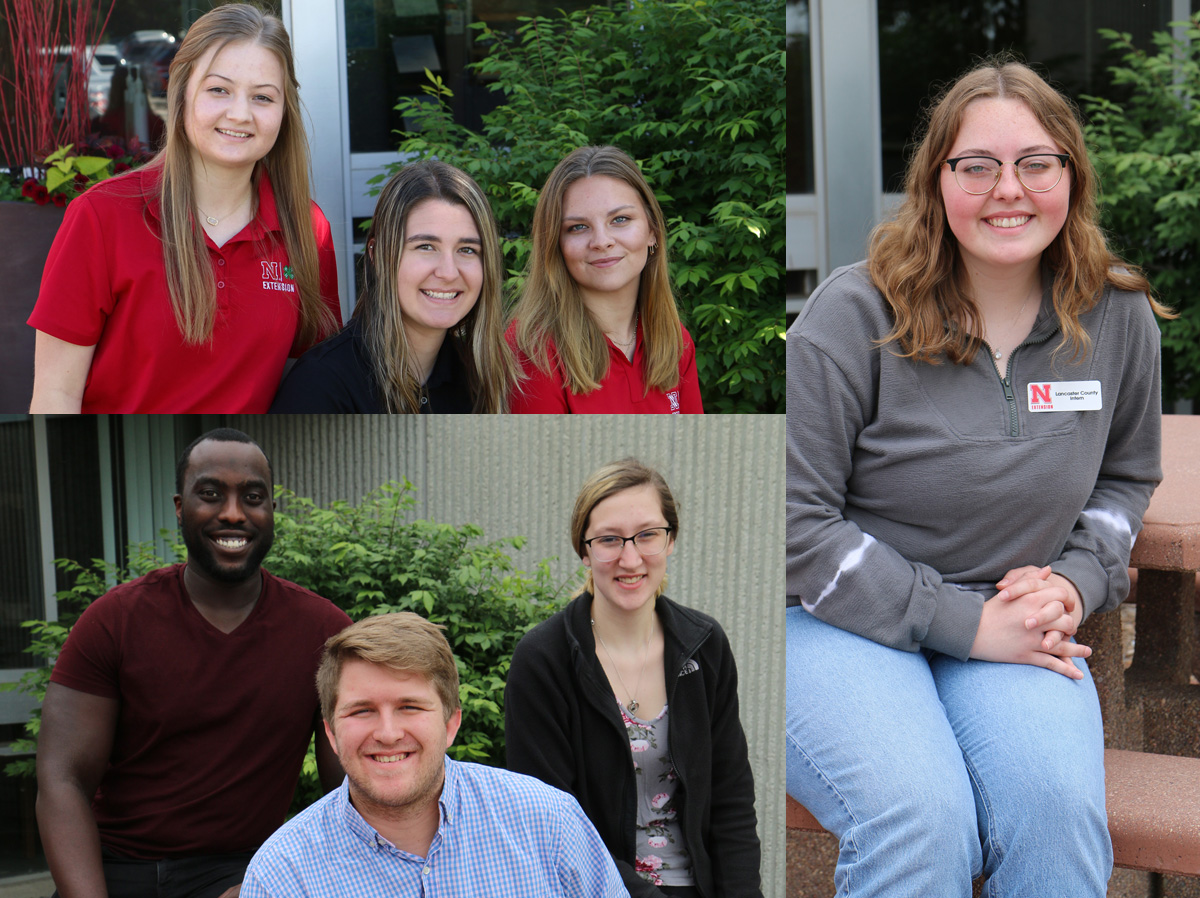
(Top left photo: L–R) Ellie Babcock, Stephanie Stephens and Jacie Pelikan;  (Bottom left photo: L–R) Matthan Sigowa, William Carbino and Taylor Sorensen;  (Right photo) Krista Price
(Top left photo: L–R) Ellie Babcock, Stephanie Stephens and Jacie Pelikan; (Bottom left photo: L–R) Matthan Sigowa, William Carbino and Taylor Sorensen; (Right photo) Krista Price

Each summer, student interns join the Lancaster County 4-H staff.

Three full-time EXTENSION INTERNS help with ongoing summer programming, including contests, Lancaster County Super Fair and other activities.
• Ellie Babcock assists with static exhibits and contests. She is an upcoming junior at University of Nebraska–Lincoln.
• Stephanie Stephens assists with the livestock, dog and poultry projects. She is an upcoming senior at UNL.
• Jacie Pelikan assists with the horse, rabbit, cat and household pet projects. She is an upcoming junior at UNL.

Three NEAR-PEER STEM DISCOVERY INTERNS serve through a collaboration with Nebraska Extension 4-H Youth Development and identified 21st Century Community Learning Center (CLC) sites. The interns engage youth during out-of-school time at CLCs and other educational 4-H programs.
• Matthan Sigowa is from Lincoln and is an upcoming junior at UNL.
• William Carbino is from Lake Helen, Fla. and is an upcoming senior at UNL.
• Taylor Sorensen is from Fremont and is an upcoming senior at UNL.

One WHY WE SCIENCE THROUGH 4-H GRANT INTERN presented the iGrow program to youth.
• Krista Price is from Grand Island and is an upcoming sophomore at UNL.

Developers beware: AI pair programming comes with pitfalls

AI pair programming tools, designed to speed up development, bring benefits ranging from suggestions for simple lines of code to the ability to build and deploy entire applications, but the pitfalls are significant.

In addition to improving productivity by alleviating some of the more mundane coding tasks, developers who use AI pair programming tools experience less frustration and can focus on more satisfying work, according to a GitHub survey of 2,000 developers. An array of these tools exist, including this year’s releases GitHub Copilot, Amazon CodeWhisperer and Tabnine. They joined a long list of existing AI-powered bots such as Kite Team Server, DeepMind’s AlphaCode and IBM’s Project CodeNet.

While AI pair programming shows promise in generating predictable, template-like code — reusable code snippets such as conditional statements or loops — developers should question the quality and suitability of code suggestions, said Ronald Schmelzer, managing partner with the CPMAI AI project management certification at Cognilytica.

“It runs into lots of problems around whether or not the code is applicable, security holes and bugs, and myriads of copyright issues,” he said.

Pitfalls of AI pair programming

Despite the apparent benefits — many of which were outlined in the GitHub survey — developers should be wary of AI-suggested code completions because they aren’t guaranteed to be accurate, said Chris Riley, senior manager of developer relations at marketing tech firm HubSpot. Developers must closely review any suggestions, which can negate any time saved searching developer sites for code snippets, he said.

Another area of ​​concern is supportability, Riley said. If a significant percentage of the code is AI-suggested, developers may not be able to support that code if it is the source of a production issue, he said.

In addition to questions concerning applicability and supportability, code completion bots introduce unique security concerns. While some code completion tools such as Kite Team Server can run behind a company’s firewall, others rely on public artifact repositories, which may be insecure, Riley said. For example, it may be possible for attackers to exploit the model to sneak in zero-day vulnerabilities, he said.

Community-provided code adds another potentially significant stumbling block: copyright issues. As AI pair programming tools are trained on a wide range of code with various licensing agreements, it becomes difficult to ascertain ownership, Cognilytica’s Schmelzer said. In addition, if the code generator is being trained on data from a shared code repository — especially GitHub — then developers could mix copyrighted or private code with public code without any identified source, he said.

The rise of AI pair programming

Many of the issues with modern AI pair programming tools weren’t present in early code completion products, such as Microsoft’s IntelliSense, which was first introduced in 1996. These tools gave developers simple type-ahead completion within the compiler or IDE, without a public repository vulnerabilities or supportability concerns. Developers could take this basic code completion a step further with linters — tools that can prevent simple syntax errors — to check the suggested code, Riley said.

I don’t think we are at the point where these tools can be used beyond rapid prototyping, education and suggestions.

Chris RileySenior manager of developer relations, HubSpot

“I don’t think developers at this point had any expectations outside of that, and we were happy with the Google-style suggestions as you typed,” Riley said. “It was there to increase efficiency, not to be the initial source of the code.”

Modern AI pair programmers go beyond simple code completion and linting into suggesting full blocks of code, Riley said. The tools can provide contextual code completions or write complete functions; Advanced text generators powered by OpenAI’s GPT-3 — such as Copilot — can build and deploy entire applications and transform simple English queries into SQL statements that work across databases.

“After being a longtime skeptic of the genuineness of the AI-driven code completion tools, I’ll have to admit it seemed surreal the first time I tried [Copilot],” said Anthony Chavez, founder and CEO of Codelab303. “I feel like it could read my mind at times.”

But despite the technological advances, the issues surrounding modern AI code completion tools mean they’re limited in their utility, Riley said.

“I don’t think we are at the point where these tools can be used beyond rapid prototyping, education and suggestions,” he said.

Our students became Polish Champions in PLC programming / News / Lublin University of Technology

Kamil Zarajczyk, BEng and Filip Szewczyk, students of the robotization of manufacturing processes, as well as members of the Student Scientific Club of Robotization and Computer Science Applications, took first place at the Student Automation Championship in programming logic controllers in industrial machines. Our team defeated 50 teams from all over Poland. The final of the Championship was held on October 5, 2022 in Olsztyn, during the 5th Specialist Conference “Automation and Robotization of Industry”.

The organizers of the competition assured: – Industrial automation is a fantastic industry and we want to attract as many people as possible by showing them what the work of automation specialists is all about. The Student Automation Championship gives you the opportunity to showcase your skills and enables developers to start building their personal brand.

The main goal of the competition is to popularize PLC programming among future industrial automation programmers.

– The subject of the competition, ie PLC, is a microprocessor responsible for controlling the machine.

PLC programming is all about writing algorithms that make the device perform specific actions – says Dr. Eng. Łukasz Sobaszek, supervisor of the Student Scientific Club of Robotization and Computer Science Applications.

The first stage of the competition was about solving tasks in the field of general knowledge of automation, as well as the ability to interpret and write PLC code. In the second stage, the participants solved a practical problem which concerned programming a simulated production line. In the final stage, the four best teams from Poland had to develop a program to control the high-bay warehouse. The final task included a number of requirements in the fields of system operation modes, safety systems operation, counting elements, or the implementation of the defined priority rule.

– I’m proud of my students. They perfectly used the knowledge gained during the classes at LUT and working in the research club. Our club is open to all people interested in modern software used in the broadly understood computer support of manufacturing processes and robotization of production – emphasizes Dr. Eng. Łukasz Sobaszek.

The organizers of the competition were: the job portal ‘RobotaAutomatyka.pl’, the Alnea company, as well as the organizers of the ‘Automation and Robotization of Industry’ conference.