Dividend stocks: Marico, DB Corp, Sonata Software, 6 others to trade ex-dividend today

Dividend stocks 2023: Shares of DB Corp Ltd, Marico Ltd, Oriental Carbon & Chemicals Ltd, Siyaram Silk Mills Ltd, Sonata Software Ltd, Supreme Industries Ltd, Transport Corporation of India Ltd, Vaibhav Global Ltd, and Venus Pipes & Tubes Ltd will be in focus when the stock market opens today.

The board of directors of these companies have declared dividends for their eligible shareholders.

DB Corp Ltd has declared an interim dividend of Rs 2 per share, the Marico Ltd board has declared a Rs 3 per share interim dividend, Oriental Carbon & Chemicals Ltd has declared an Rs 7 per share interim dividend, Siyaram Silk Mills Ltd has announced Rs 4 per share interim dividend, Sonata Software Ltd has declared an interim dividend of 7 per share, Supreme Industries Ltd has declared an interim dividend of 8 per share, Transport Corporation of India Ltd has declared an interim dividend of 2.5 per share, Vaibhav Global Ltd has declared an interim dividend of 1.5 per share, and Venus Pipes & Tubes Ltd has declared Rs 0.50 per share interim dividend.

Marico— The FMCG major reported a 17.26% increase in consolidated net profit at 360 crore for the September quarter of 2023-24, driven by softer input costs. Its revenue from operations is marginally reduced to 2,476 crore during the quarter from 2,496 crore a year ago.

DB Corp – It reported net sales at 586.04 crore in the September quarter of fiscal year 2024, up 8.85% from 538.40 crore a year ago. Its quarterly net profit stood at 100.26 crore, up 105.53% from 48.78 crore a year ago. Ebitda stood at 167.57 crore in Q2 FY24, up 71.41% from 97.76 crore a year ago.

Sonata Software— The IT services and technology company reported 28% YoY growth in consolidated revenue at 1,912.6 crore for the second quarter ended 30 September 2023. Its EBITDA stood at 220.5 crore, up 33% YoY. Its PAT (profit after tax) stood at 124.2 crore, a growth of 10% YoY.

Supreme Industries–Supreme Industries Ltd posted around a three-fold jump in its profit after tax at 243.19 crore in the quarter ended September 2023, pushed by higher income. Its total income rose to 2,321.38 crore from 2,092.12 in the year-ago quarter.

Transport Corporation Of India— TCI reported a 20.3% rise in consolidated net profit to 87 crore for the quarter ended September 30, 2023. Its consolidated total income in the July-September period increased to 1,004.8 crore over 939.5 crore a year ago.

Oriental Carbon & Chemicals— The company reported a net profit of 8.96 crore in the September quarter of FY 2024, down 4.91% from 9.43 crore a year ago. Its net sales stood at 111.43 crore in the September quarter, down 20.92% from 140.91 crore last fiscal year. Ebitda stood at 24.12 crore in Q2 FY24, down 3.33% from 24.95 crore a year ago.

Siyaram Silk Mills— The company reported a net profit of 61.29 crore in the September quarter of FY 2024, down 23.51% from 80.13 crore a year ago. Its net sales stood at 585.91 crore in the September quarter, down 7.84% from 635.76 crore last fiscal year. Ebitda stood at 99.75 crore in Q2 FY24, down 22.51% from 128.72 crore a year ago.

Vaibhav Global– The company reported a net profit of 29.37 crore in the September quarter of FY 2024, up 28.08% from 22.93 crore a year ago. Its net sales stood at 705.00 crore in the September quarter, up 9.09% from Rs. 646.26 crore last fiscal year. Ebitda stood at 66.91 crore in Q2 FY24, up 28.52% from 52.06 crore a year ago.

Venus Pipes & Tubes— The company reported a 94% jump in its profit after tax (PAT) at 20.2 crore for the second quarter of this fiscal year, compared with 10 crore in the year-ago quarter. Its total sales in the second quarter of this fiscal jumped 51.3% to 191.3 crore, compared to 126.4 crore in the same period last year.

Disclaimer: The views and recommendations made above are those of individual analysts or brokering companies, and not of Mint. We advise investors to check with certified experts before taking any investment decision.

Unlock a world of Benefits! From insightful newsletters to real-time stock tracking, breaking news and a personalized newsfeed – it’s all here, just a click away! Login Now!

Catch all the Business News, Market News, Breaking News Events and Latest News Updates on Live Mint. Download The Mint News App to get Daily Market Updates.

More Less

Published: 07 Nov 2023, 06:40 AM IST

Newgen Software share price rallies over 4% after Jefferies raises target

Newgen Software Technologies share price rallied over 4% on Monday after foreign brokerage firm Jefferies raised target price on the stock. Newgen Software shares gained as much as 4.16% to 1,474.00 apiece on the BSE.

Jefferies maintained a ‘Buy’ rating on Newgen Software Technologies and raised the target price to 1,740 per share, based on 35x PE, implying a PEG of 1.3x, from earlier 1,275.

The brokerage said it was more confident on Newgen’s growth outlook and raised its revenue estimates by 2-3% and EPS estimates by 2-4%.

“We expect Newgen to deliver a strong 26% EPS Cagr over FY24-26E,” Jefferies said.

Also Read: BSE share price has more 25% upside potential, says Sharekhan; here’s why

At its Annual event, Newgen Software’s management highlighted that growth outlook remains strong and recent bookings offer comfort on FY24 growth. The strong growth outlook is driven primarily by India and the Middle East – its core markets – while it continues to scale up in APAC. Management continues to step up efforts to gain traction in the US, especially among the mid-large tier banks.

India is witnessing strong traction and deal sizes have increased by 40% over the last year. Its trade finance product has had 9 large deal wins and provides strong growth visibility in the future.

(Exciting news! Mint is now on WhatsApp Channels :rocket: Subscribe today by clicking the link and stay updated with the latest financial insights! Click here!)

The company’s management highlighted that Newgen’s gross margins could expand by 10-12 ppts once they reach a topline of $350 million. However, management plans to re-invest most of the potential margin improvement either to scale up its marketing efforts or to invest in product development in order to accelerate growth.

“This should limit Ebitda margin expansion in the future. We thus expect our FY24-26 margins to remain around the 22% range,” Jefferies said.

Also Read: BCL Industries shares hit life-time high on ethanol supply orders from OMCs

In its base case scenario, the brokerage expects the company to deliver revenue growth of 24% Cagr and EBITDA margin of 22% over FY24-26E.

The key catalyst for the stock would be traction in deal wins, including in the US, leading to higher-than-expected revenue growth, beat in margins, lower receivable/debtor days and favorable currency movement, according to Jefferies.

At 2:40 pm, Newgen Software Technologies shares were trading 1.20% higher at 1,432.00 apiece on the BSE.

Catch Live Market Updates here

Disclaimer: The views and recommendations made above are those of individual analysts or brokering companies, and not of Mint. We advise investors to check with certified experts before taking any investment decisions.

Unlock a world of Benefits! From insightful newsletters to real-time stock tracking, breaking news and a personalized newsfeed – it’s all here, just a click away! Login Now!

Catch all the Business News, Market News, Breaking News Events and Latest News Updates on Live Mint. Download The Mint News App to get Daily Market Updates.

More Less

Published: 04 Dec 2023, 02:42 PM IST

Unity Software to lay off 1,800 employees, 25% of staff

Pavlo Gonchar | Lightrocket | Getty Images

Unity Software said Monday that it’s cutting 1,800 jobs, or about 25% of its workforce, in the latest round of layoffs at the gaming technology company. The stock jumped almost 5% in extended trading.

Unity said in a regulatory filing that the cuts were part of a corporate restructuring plan. The company told investors in November that it would implement a “comprehensive assessment” of its product portfolio and conduct a financial evaluation that would “likely include discontinuing certain product offerings, reducing our workforce, and reducing our office footprint.”

In the filing, Unity said it’s unable to “reasonably estimate the costs and charges in connection with this reduction, which it expects will be substantially substantial in the first quarter of 2024.”

It has been a rough past year for Unity. In May, the company announced a round of layoffs that affected 600 employees, or about 8% of its workforce, a move Unity said was intended to help generate “long-term and profitable growth.”

In September, Unity announced a pricing change that upset numerous developers who rely on the company’s technology to create video games. A consortium of game developers protested the change, saying in a public letter that it “jeopardizes small and large game developers alike” and was “made without any industry consultation.”

The following month, John Riccitiello retired as Unity’s CEO, also stepping down as chairman and leaving the board. James Whitehurst, the former CEO of Red Hat, was named interim CEO while Roelof Botha, the lead independent director of Unity’s Board and a Sequoia Capital partner, became chairman.

While the shares rose more than 40% for the year, they lost almost half their value between July and the end of October. In its third-quarter earnings report, Unity missed analysts’ expectations and didn’t issue quarterly guidance.

“Our results in the third quarter were mixed,” Unity said at the time in a letter to shareholders. “While revenue comes within guidance, we believe we can do better.”

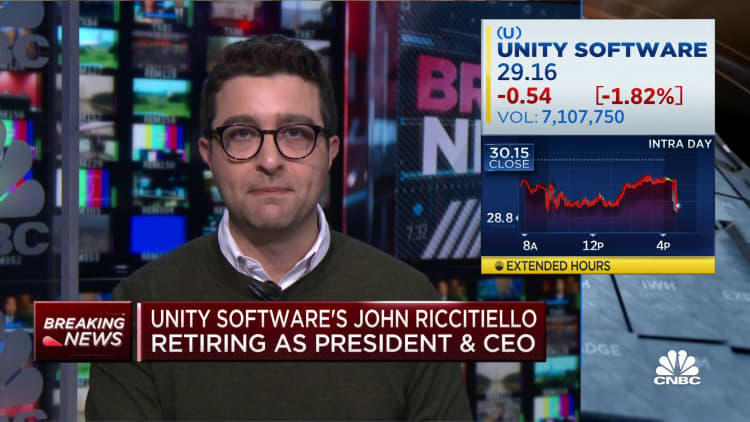
WATCH: Unity Software’s John Riccitiello retires as president and CEO

Unity Software's John Riccitiello retires as president and CEO

Don’t miss these stories from CNBC PRO:

Turquoise Health Raises $30M for its Price Transparency Software

price transparency

Hospitals’ compliance with price transparency laws has increased In the past year, with most hospitals currently displaying the cost data they need to in order to comply significantly with the regulations. That wasn’t always the case, though. Hospitals had a difficult time meeting CMS’ price transparency requirements during the first two years they were enforced — a JAMA study published a year and a half after the rule went into effect showed that fewer than 6% of US hospitals were fully compliant.

To achieve compliance, many health systems have turned to technology vendors for assistance. One of these vendors — Turquoise Healtha San Diego-based startup selling software to reduce the complexity of healthcare pricing data — announced a new funding round on Tuesday.

The startup, which was founded in 2020, completed a $30 million Series B round, which brings its total funding to date to $55 million. The financing round was led by Adams Street Partnerswith participation from Andreessen Horowitz, BoxGroup and Yosemite. Adams Street Partner Tom Bremner will join Turquoise’s board of directors.

“Healthcare pricing remains frustratingly opaque for many industry stakeholders, including pattention,” Bremner said in a statement. “Turquoise tackles this problem head-on with a sophisticated, multi-stakeholder platform that ultimately makes healthcare pricing and packaging look easy. I am excited to partner with the team as they scale towards a seamless healthcare transaction.”

CMS began enforcing it price transparency rules on the first day of 2021. The law requires hospitals to post their gross charges, payer-specific negotiated charges, de-identified minimum negotiated charges, de-identified maximum negotiated charges and cash prices on their websites in a machine-readable file. It also mandates that hospitals must publish pricing for the 300 most commonly used services to their website in a consumer-friendly manner.

In July 2022, CMS began requiring payers to post price transparency data as well. Payers are required to post rate data for more than the services they cover at hospitals — they must publish data for all types of providers, such as imaging centers, family practice clinics, and ambulatory surgery centers.

Both hospitals and payers are required to post massive amounts of data in a consumer-friendly manner, which isn’t an easy task given the highly complex and variable nature of healthcare financial data, Turquoise CEO Chris Severn pointed out.

The complicated structure of the healthcare system — from care variance to deductibles to billing codes — means that producing an accurate price estimate is incredibly challenging. For example, there is no single price for a colonoscopy or hysterectomy. In order to figure out how much a procedure will actually cost a patient, a number of variables need to be considered, such as the facility fee, doctor’s procedure fee and anesthesia fee.

That’s why Turquoise built software to quickly gather that information and determine what a patient’s health plan will pay for. The startup’s platform provides direct access to price transparency data via a search engine, as well as tools for data viewing and reporting. Overall, this platform makes it easier to quickly provide patients with an accurate price quote, Severn explained.

Turquoise has more than 160 customers, including providers, payers, employers, consultants, health tech companies, pharmaceutical firms and medical device makers. These customers contribute to the startup’s revenue via three streams, which Severn categorized as “data, contracts and compliance.”

The data revenue stream refers to customers who buy access to negotiated rates and cash prices from providers and payers across the country. The contracts stream encompasses those that use Turquoise’s contract intelligence platform, which leverages AI to enable contract organization and insights. As for the compliance stream, this involves customers that use Turquoise’s compliance tools designed for CMS’ price transparency laws and the No Surprises Act.

There are other companies out there that also help healthcare organizations understand costs and negotiate accordingly, like Accenture, Deloitte and Healthcare Bluebook. Severn declined to answer MedCity News‘ question asking how Turquoise differentiates itself from competitors such as these.

Photo: cinemaslow, Getty Images

IBM expands its software portfolio to India and 92 other nations in AWS Marketplace | Technology News

Tech giant IBM has announced that it is expanding its software portfolio globally to 92 countries in AWS Marketplace. For the uninitiated, AWS Marketplace is a digital catalog that features thousands of software listings from independent software vendors or (ISVs) making it easier to search, test, purchase, and deploy software that runs on Amazon Web Services (AWS).

This expansion beyond Denmark, Germany, France, the UK, and the US will make it easy for clients to streamline purchasing and create new efficiencies. Based on a recent study by Canalys, cloud marketplaces like AWS continue to emerge as the fastest-growing route to market for Software-as-a-Service (SaaS) software. This is expected to increase to $45 billion by 2025, up 84 per cent CAGR over five years. It needs to be noted that marketplaces also help shorten the buying cycle, consolidate billing, and make it easier to scale software deployments instantly.

With the latest development, companies will now have access to IBM’s AI and data technologies within a portfolio of 44 listings and 29 SaaS offerings available for purchase. The listed technologies include WatsonX AI and a data platform that allows companies to build, scale, and manage AI workloads. Watsonx.data, a fit-for-purpose data store built on an open data lakehouse architecture, and Watsonx.ai, a next-generation enterprise studio for AI builders are available in the AWS Marketplace as well as two of IBM’s AI Assistants — watsonx Assistant and watsonx Orchestrate. Watsonx. governance is expected to be available soon.

Other software includes IBM’s flagship database Db2 Cloud Pak for Data and a portfolio of automation software including Apptio, Turbonomic, and Instana, and the IBM Security and Sustainability software portfolios − all built on Red Hat OpenShift Service on AWS. The cloud-native software enables clients to deploy on AWS while flexible licensing, including SaaS and subscription, makes it easier for clients to purchase exactly how they want.

IBM is also launching 15 new IBM Consulting professional services and assets on AWS Marketplace, exclusively designed for AWS. “By expanding the availability of our software portfolio in AWS Marketplace, organizations around the world will have greater access to a streamlined way to procure many IBM AI and hybrid cloud offerings to help propel their business forward,” said Nick Otto, Head of Global Strategic Partnerships, IBM.


Sonata Software dividend, bonus date announced—check out record date, payment date

Sonata Software dividend record date, Sonata Software dividend payment date, Software bonus news: Sonata Software announced on Wednesday, October 25, a 700 per cent dividend payout and a bonus issue for its shareholders, along with its September quarter earnings, post-market hours. Sonata Software declared an interim dividend of Rs 7 per share of a face value of Rs 1, i.e., a 700 per cent payout for the financial year 2023–24.

Sonata Software dividend record date

The record date for the purpose of payment of the interim dividend has been fixed as November 7, 2023.

Sonata Software dividend payment date

As per the company’s communiqué, the interim dividend will be paid to the registered shareholders on or after November 22, 2023, through electronic mode or by dividend warrants, as applicable.

Sonata Software bonus news

In addition, the board has also approved and recommended a bonus issue of one equity share for every one equity share held by the shareholders of the company as on the record date, ie, in the ratio of 1:1.

“The bonus issue of equity shares will be subject to approval by the shareholders through postal ballot and any other applicable statutory law
and regulatory approvals,” the company’s regulatory filing read.

“The bonus shares, once allocated, shall rank pari-passu in all respects and carry the same rights as the existing equity shares and shall be entitled to participate in full in any dividend and other corporate action, recommended and declared after the new equity shares are allocated,” the filing further said.

Catch the latest stock market updates here. For all other news related to business, politics, tech, sports and auto, visit Zeebiz.com.

NVIDIA Brings Generative AI to Millions, With Tensor Core GPUs, LLMs, Tools for RTX PCs and Workstations

Leading AI Platform Gets RTX-Accelerated Boost From New GeForce RTX SUPER GPUs, AI Laptops From Every Top Manufacturer

CES — NVIDIA today announced GeForce RTX SUPER desktop GPUs for supercharged generative AI performance, new AI laptops from every top manufacturer, and new NVIDIA RTX-accelerated AI software and tools for both developers and consumers.

Building on decades of PC leadership, with over 100 million of its RTX GPUs driving the AI ​​PC era, NVIDIA is now offering these tools to enhance PC experiences with generative AI: NVIDIA TensorRT acceleration of the popular Stable Diffusion XL model for text-to-image workflows, NVIDIA RTX Remix with generative AI texture tools, NVIDIA ACE microservices and more games that use DLSS 3 technology with Frame Generation.

AI Workbench, a unified, easy-to-use toolkit for AI developers, will be available in beta later this month. In addition, NVIDIA TensorRT-LLM (TRT-LLM), an open-source library that accelerates and optimizes inference performance of the latest large language models (LLMs), now supports more pre-optimized models for PCs. Accelerated by TRT-LLM, Chat with RTXan NVIDIA tech demo also releasing this month, allows AI enthusiasts to interact with their notes, documents and other content.

“Generative AI is the single most significant platform transition in computing history and will transform every industry, including gaming,” said Jensen Huang, founder and CEO of NVIDIA. “With over 100 million RTX AI PCs and workstations, NVIDIA is a massive installed base for developers and gamers to enjoy the magic of generative AI.”

Running generative AI locally on a PC is critical for privacy, latency and cost-sensitive applications. It requires a large installed base of AI-ready systems, as well as the right developer tools to tune and optimize AI models for the PC platform.

To meet these needs, NVIDIA is delivering innovations across its full technology stack, driving new experiences and building on the 500+ AI-enabled PC applications and games already accelerated by NVIDIA RTX technology.

RTX AI PCs and Workstations
NVIDIA RTX GPUs — capable of running a broad range of applications at the highest performance — unlock the full potential of generative AI on PCs. Tensor Cores in these GPUs dramatically speed AI performance across the most demanding applications for work and play.

The new GeForce RTX 40 SUPER Series graphics cards, also announced today at CES, include the GeForce RTX 4080 SUPER, 4070 Ti SUPER and 4070 SUPER for top AI performance. The GeForce RTX 4080 SUPER generates AI videos 1.5x faster — and images 1.7x faster — than the GeForce RTX 3080 Ti GPU. The Tensor Cores in SUPER GPUs deliver up to 836 trillion operations per second, bringing transformative AI capabilities to gaming, creating and everyday productivity.

Leading manufacturers — including Acer, ASUS, Dell, HP, Lenovo, MSI, Razer and Samsung — are releasing a new wave of RTX AI laptops, bringing a full set of generative AI capabilities to users right out of the box. The new systems, which deliver a performance increase ranging from 20x-60x compared with using neural processing units, will start shipping this month.

Mobile workstations with RTX GPUs can run NVIDIA AI Enterprise software, including TensorRT and NVIDIA RAPIDS for simplified, secure generative AI and data science development. A three-year license for NVIDIA AI Enterprise is included with every NVIDIA A800 40GB Active GPUproviding an ideal workstation development platform for AI and data science.

New PC Developer Tools for Building AI Models
To help developers quickly create, test and customize pretrained generative AI models and LLMs using PC-class performance and memory footprint, NVIDIA recently announced NVIDIA AI Workbench.

AI Workbench, which will be available in beta later this month, offers streamlined access to popular repositories like Hugging Face, GitHub and NVIDIA NGC, along with a simplified user interface that enables developers to easily reproduce, collaborate on and migrate projects.

Projects can be scaled out to virtually anywhere — whether the data center, a public cloud or NVIDIA DGX Cloud — and then brought back to local RTX systems on a PC or workstation for inference and light customization.

In collaboration with HP, NVIDIA is also simplifying AI model development by integrating NVIDIA AI Foundation Models and Endpointswhich includes RTX-accelerated AI models and software development kits, into the HP AI Studio, a centralized platform for data science. This will allow users to easily search, import and deploy optimized models across PCs and the cloud.

After building AI models for PC use cases, developers can optimize them using NVIDIA TensorRT to take full advantage of RTX GPUs’ Tensor Cores.

NVIDIA recently extended TensorRT to text-based applications with TensorRT-LLM for Windows, an open-source library for accelerating LLMs. The latest update to TensorRT-LLM, available now, adds Phi-2 to the growing list of pre-optimized models for PC, which run up to 5x faster compared to other inference backends.

RTX-Accelerated Generative AI Powers New PC Experiences
At CES, NVIDIA and its developer partners are releasing new generative AI-powered applications and services for PCs, including:

  • NVIDIA RTX Remixa platform for creating stunning RTX remasters of classic games. Releasing in beta later this month, it delivers generative AI tools that can transform basic textures from classic games into modern, 4K-resolution, physically based rendering materials.
  • NVIDIA ACE microservices, including generative AI-powered speech and animation models, which enable developers to add intelligent, dynamic digital avatars to games.
  • TensorRT acceleration for Stable Diffusion XL (SDXL) Turbo and latent consistency models, two of the most popular Stable Diffusion acceleration methods. TensorRT improves performance for both by up to 60% compared with the previous fastest implementation. An updated version of the Stable Diffusion WebUI TensorRT extensions are also now available, including acceleration for SDXL, SDXL Turbo, LCM – Low-Rank Adaptation (LoRA) and improved LoRA support.
  • NVIDIA DLSS 3 with Frame Generation, which uses AI to increase frame rates up to 4x compared with native rendering, will be featured in a dozen of the 14 new RTX games announced, including Horizon Forbidden West, Pax Dee and Dragon’s Dogma 2.
  • Chat with RTX, an NVIDIA tech demo available later this month, allows AI enthusiasts to easily connect PC LLMs to their own data using a popular technique known as retrieval-augmented generation (RAG). The demo, accelerated by TensorRT-LLM, enables users to quickly interact with their notes, documents and other content. It will also be available as an open-source reference project, so developers can easily implement the same capabilities in their own applications.

Learn more about the latest generative AI breakthroughs by joining NVIDIA at CES.

Is Constellation Software (TSE:CSU) A Risky Investment?

Legendary fund manager Li Lu (who Charlie Munger backed) once said, ‘The biggest investment risk is not the volatility of prices, but whether you will suffer a permanent loss of capital.’ When we think about how risky a company is, we always like to look at its use of debt, since debt overload can lead to ruin. Importantly, Constellation Software Inc. (TSE:CSU) does carry debt. But the more important question is: how much risk is that debt creating?

When Is Debt Dangerous?

Debt and other liabilities become risky for a business when it cannot easily fulfill those obligations, either with free cash flow or by raising capital at an attractive price. If things get really bad, the lenders can take control of the business. However, a more common (but still painful) scenario is that it has to raise new equity capital at a low price, thus permanently diluting shareholders. Of course, plenty of companies use debt to fund growth, without any negative consequences. The first thing to do when considering how much debt a business uses is to look at its cash and debt together.

View our latest analysis for Constellation Software

What Is Constellation Software’s Net Debt?

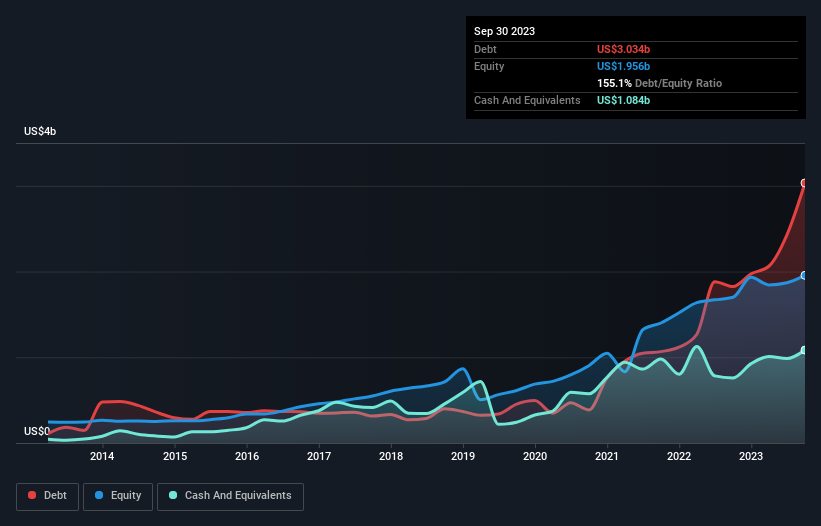
You can click the graphic below for the historical numbers, but it shows that as of September 2023 Constellation Software had US$3.03b of debt, an increase on US$1.83b, over one year. On the flip side, it has US$1.08b in cash leading to net debt of about US$1.95b.

debt-equity-history-analysis
TSX:CSU Debt to Equity History January 7th 2024

A Look At Constellation Software’s Liabilities

Zooming in on the latest balance sheet data, we can see that Constellation Software has liabilities of US$5.10b due within 12 months and liabilities of US$2.95b due beyond that. On the other hand, it has cash of US$1.08b and US$1.55b worth of receivables due within a year. So its liabilities outweigh the sum of its cash and (near-term) receivables by US$5.42b.

Given Constellation Software has a humongous market capitalization of US$53.1b, it’s hard to believe these liabilities pose much threat. Having said that, it’s clear that we should continue to monitor its balance sheet, let it change for the worse.

We use two main ratios to inform us about debt levels relative to earnings. The first is net debt divided by earnings before interest, tax, depreciation, and amortization (EBITDA), while the second is how many times its earnings before interest and tax (EBIT) covers its interest expense (or its interest cover, for short) . The advantage of this approach is that we take into account both the absolute quantum of debt (with net debt to EBITDA) and the actual interest expenses associated with that debt (with its interest cover ratio).

With a debt to EBITDA ratio of 1.6, Constellation Software uses debt artfully but responsibly. And the fact that its trailing twelve months of EBIT was 7.4 times its interest expenses harmonizes with that theme. Another good sign is that Constellation Software has been able to increase its EBIT by 21% in twelve months, making it easier to pay down debt. The balance sheet is clearly the area to focus on when you are analyzing debt. But ultimately the future profitability of the business will decide if Constellation Software can strengthen its balance sheet over time. So if you want to see what the professionals think, you might find this free report on analyst profit forecasts to be interesting.

Finally, a business needs free cash flow to pay off debt; accounting profits just don’t cut it. So we always check how much of that EBIT is translated into free cash flow. Happily for any shareholders, Constellation Software actually produced more free cash flow than EBIT over the last three years. There’s nothing better than incoming cash when it comes to staying in your lenders’ good graces.

Our View

The good news is that Constellation Software’s demonstrated ability to convert EBIT to free cash flow delights us like a fluffy puppy does a toddler. And the good news doesn’t stop there, as its EBIT growth rate also supports that impression! Looking at the bigger picture, we think Constellation Software’s use of debt seems quite reasonable and we’re not concerned about it. While debt does bring risk, when used wisely it can also bring a higher return on equity. There’s no doubt that we learn most about debt from the balance sheet. But ultimately, every company can contain risks that exist outside of the balance sheet. To that end, you should be aware of the 2 warning signs we’ve spotted with Constellation Software .

When all is said and done, sometimes it’s easier to focus on companies that don’t even need debt. Readers can access a list of growth stocks with zero net debt 100% freeright now.

Valuation is complex, but we’re helping make it simple.

Find out whether Constellation Software is potentially over or undervalued by checking out our comprehensive analysis, which includes fair value estimates, risks and warnings, dividends, insider transactions and financial health.

View the Free Analysis

Have feedback on this article? Concerned about the content? Get in touch with us directly. Alternatively, email editorial-team (at) simplywallst.com.

This article by Simply Wall St is general in nature. We provide commentary based on historical data and analyst forecasts only using an unbiased methodology and our articles are not intended to be financial advice. It does not constitute a recommendation to buy or sell any stock, and does not take account of your objectives, or your financial situation. We aim to bring you long-term focused analysis driven by fundamental data. Note that our analysis may not factor in the latest price-sensitive company announcements or qualitative material. Simply Wall St has no position in any stocks mentioned.