Military technology on display at Tampa trade show

At the Tampa Convention Center, the trade show floor is set up for an international event like no other.

“If you look around this show, there are all these different sensors, things that fly, things that shoot,” says Tampa native and former Army Green Beret Paul Greaves.

The trade show is part of SOF Week. SOF stands for Special Operations Forces. They are small units of highly trained military forces from all branches that range from Delta Force to Navy SEALs.
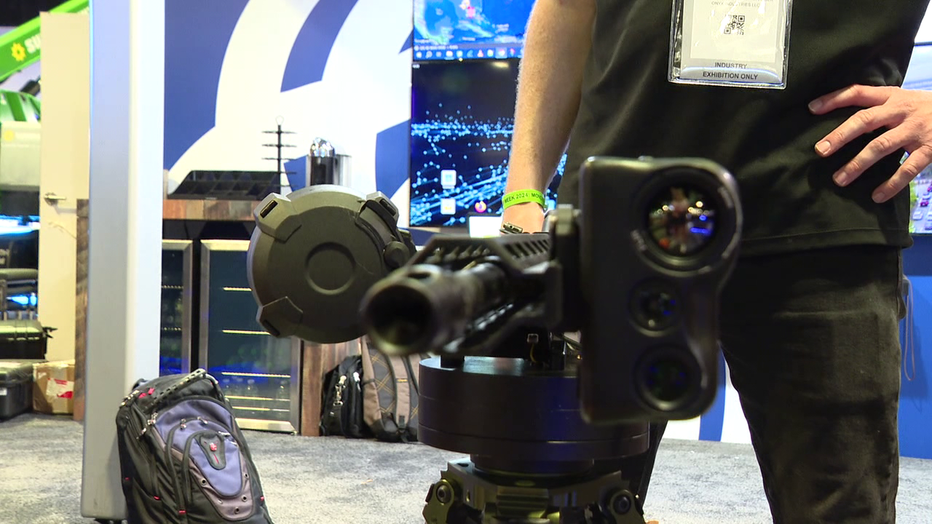
For hostage rescues and other dangerous Special Operations missions, they increasingly rely on the most advanced technology for a view of the battlefield and to control drones, remotely operated guns, and weapons and surveillance systems.

“If you look around, it’s pretty much the whole show is about technologically linked equipment,” says Greaves, who now works for a company called Persistent Systems, which provides technology systems for the military.

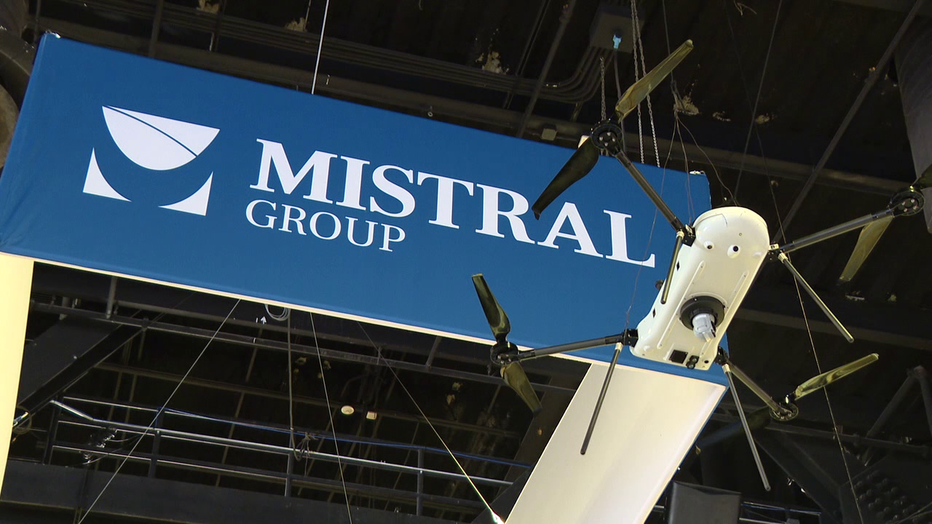
Many drones are on display. They’re becoming preferred weapons on new battlefields in a kind of technological chess match.
“It’s constantly evolving back and forth. We just try to stay ahead of them with our capabilities,” says Justin Litko, of Blue Halo.

That company provides electric powered water drones that can run 500 miles, either on the surface or underwater.

“A scenario would be if you’re trying to get a drone a far distance and there is only water between you and where you’re trying to take the drone.”

READ: Military Appreciation Month 2024 deals, discounts

The sea drone can carry an air drone and launch it with little fear of detection.

Tampa is a natural location for the event. MacDill Air Force Base houses US Special Operations Command (SOCOM), which is in command of US Special Operations units from all branches of the military around the world.

Wednesday is the annual special operations demonstration at the Convention Center that simulates a special operation with troops dropped in by helicopters and automatic weapons firing blanks. It’s sure to be loud.

But the modern warfighter really depends on silent technology in the battles we see even now. Battles where drone warfare — and seeing the battle in real time — is war in the 21st century.

SIGN UP: Click here to sign up for the FOX 13 daily newsletter

WATCH FOX 13 NEWS
New technology allows archaeologists to use particle physics to explore the past

Naples, Italy — Beneath the honking horns and operatic yelling of Naples, the most blissfully chaotic city in Italy, archaeologist Raffaella Bosso descends into the deafening silence of an underground maze, zigzagging back in time roughly 2,300 years.

Before the Ancient Romans, it was the Ancient Greeks who colonized Naples, leaving behind traces of life, and death, inside ancient burial chambers, she says.

She points a flashlight at a stone-relief tombstone that depicts the legs and feet of those buried inside.

“There are two people, a man and a woman” in this one tomb, she explains. “Normally you can find eight or even more.”

This tomb was discovered in 1981, the old-fashioned way, by digging.

Now, archeologists are joining forces with physicists, trading their pickaxes for subatomic particle detectors about the size of a household microwave.

Thanks to breakthrough technology, particle physicists like Valeri Tioukov can use them to see through hundreds of feet of rock, no matter the apartment building located 60 feet above us.

“It’s very similar to radiography,” he says, as he places his particle detector beside the damp wall, still adorned by colorful floral frescoes.

Archeologists long suspected there were additional chambers on the other side of the wall. But just to peek, they would have had to break them down.

Thanks to this detector, they now know for sure, and they didn’t even have to use a shovel.

To understand the technology at work, Tioukov takes us to his laboratory at the University of Naples, where researchers scour the images from that detector.

Specifically, they’re looking for muons, cosmic rays left over from the Big Bang.

The muon detector tracks and counts the muons passing through the structure, then determines the density of the structure’s internal space by tracking the number of muons that pass through it.

At the burial chamber, it captured about 10 million muons in the span of 28 days.

“There’s a muon right there,” says Tioukov, pointing to a squiggle line he’s blown up using a microscope.

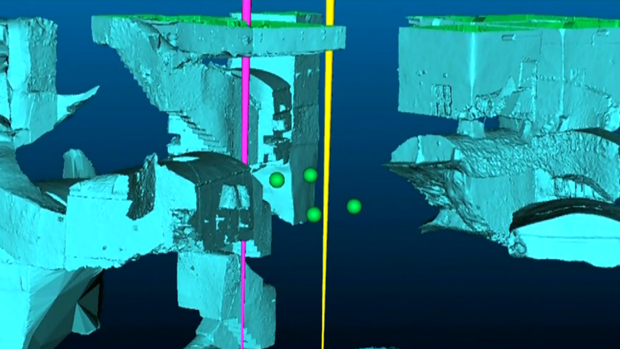
After months of painstaking analysis, Tioukov and his team were able to put together a three-dimensional model of that hidden burial chamber, closed to human eyes for centuries, now opened thanks to particle physics.

Archaeologists use high-tech subatomic particle detectors to make new discoveries
A three-dimensional model of a hidden burial chamber in Naples, Italy, that was made by researchers using particle physics. March 2024.

CBS News


What seems like science fiction is also being used to peer inside the pyramids in Egyptchambers beneath volcanoes, and even treat cancer, says Professor Giovanni De Lellis.

“Especially cancers which are deep inside the body,” he says. “This technology is being used to measure possible damage to healthy tissue surrounding the cancer. It’s very hard to predict the breakthrough that this technology could actually bring into any of these fields, because we have never observed objects with this accuracy.”

“This is a new era,” he marvels.