The Myth of the Global Village: Why Your Local Network Is All That Matters

“`html
The Myth of the Global Village: Why Your Local Network Is All That Matters
In the 1960s, media theorist Marshall McLuhan coined the term “Global Village.” He predicted that electronic technology would collapse time and space, allowing every human on earth to become intimately connected with every other human. On the surface, his prophecy has come true. We can trade stocks in Tokyo from a laptop in Topeka and message a friend in Berlin while sitting in a cafe in Buenos Aires.
However, as we move deeper into the 21st century, a stark irony has emerged. Despite our infinite digital reach, our actual influence, psychological well-being, and economic security are increasingly tied to our immediate physical surroundings. The “Global Village” is often a mile wide and an inch deep. If you want to build a resilient life and a successful career, it is time to stop obsessing over global metrics and start reinvesting in your local network.
The Digital Illusion of Connectivity
Social media platforms have tricked our brains into believing we have massive networks. We equate “followers” with “friends” and “connections” with “capital.” But research consistently shows that these digital ties are “weak ties” at best. While weak ties are useful for discovering new information, they rarely provide the support system necessary for sustained growth or crisis management.
The “Global Village” has created a paradox of choice. Because we can theoretically talk to anyone, we often end up talking to no one—or at least, no one who can actually show up at our door with a meal or a job lead when things get tough. The digital world offers breadth, but local networks offer depth. In an age of high-frequency digital noise, depth is the new currency.
Dunbar’s Number and the Limits of the Human Brain
Evolutionary psychology suggests that humans aren’t built for a global village. Evolutionary psychologist Robin Dunbar famously proposed “Dunbar’s Number,” suggesting that humans can only maintain stable social relationships with about 150 people. This is the limit of our cognitive capacity to track who everyone is and how they relate to us.
- The Inner Circle (5-15 people): Your core support system.
- The Local Tribe (50 people): Those you interact with regularly.
- The Meaningful Network (150 people): The extent of your “village.”
When we try to spread our social energy across a global scale, we dilute our influence. By focusing on a local network, you operate within the natural limits of human psychology. You build trust through repeated face-to-face interactions, a process that digital communication simply cannot replicate at the same neurochemical level.
Why Proximity Still Wins in Business
Despite the rise of remote work and Zoom, the “Proximity Effect” remains a dominant force in professional success. Studies have shown that workers who are physically closer to their colleagues are more likely to be promoted and more likely to innovate. Why? Because the most valuable information isn’t shared in formal emails; it’s shared in “water cooler” moments, impromptu lunches, and the subtle body language of a handshake.
Local networks provide several distinct advantages in business:
- High Trust: It is much harder to “ghost” someone you might run into at the local grocery store. Local accountability breeds integrity.
- Economic Recycling: Spending money with local vendors keeps capital circulating within your immediate ecosystem, which indirectly benefits your own business.
- Speed of Action: Need a plumber, a lawyer, or a graphic designer immediately? A local recommendation from a trusted peer is worth ten thousand five-star reviews on a global platform.
The Resilience of the “Hyper-Local” Ecosystem
Recent global events, from supply chain disruptions to pandemics, have highlighted the fragility of globalism. When the “Global Village” breaks down, it is the local network that steps in. Those with strong ties to their neighbors, local farmers, and local business owners found themselves far more resilient than those who relied solely on global distribution networks.
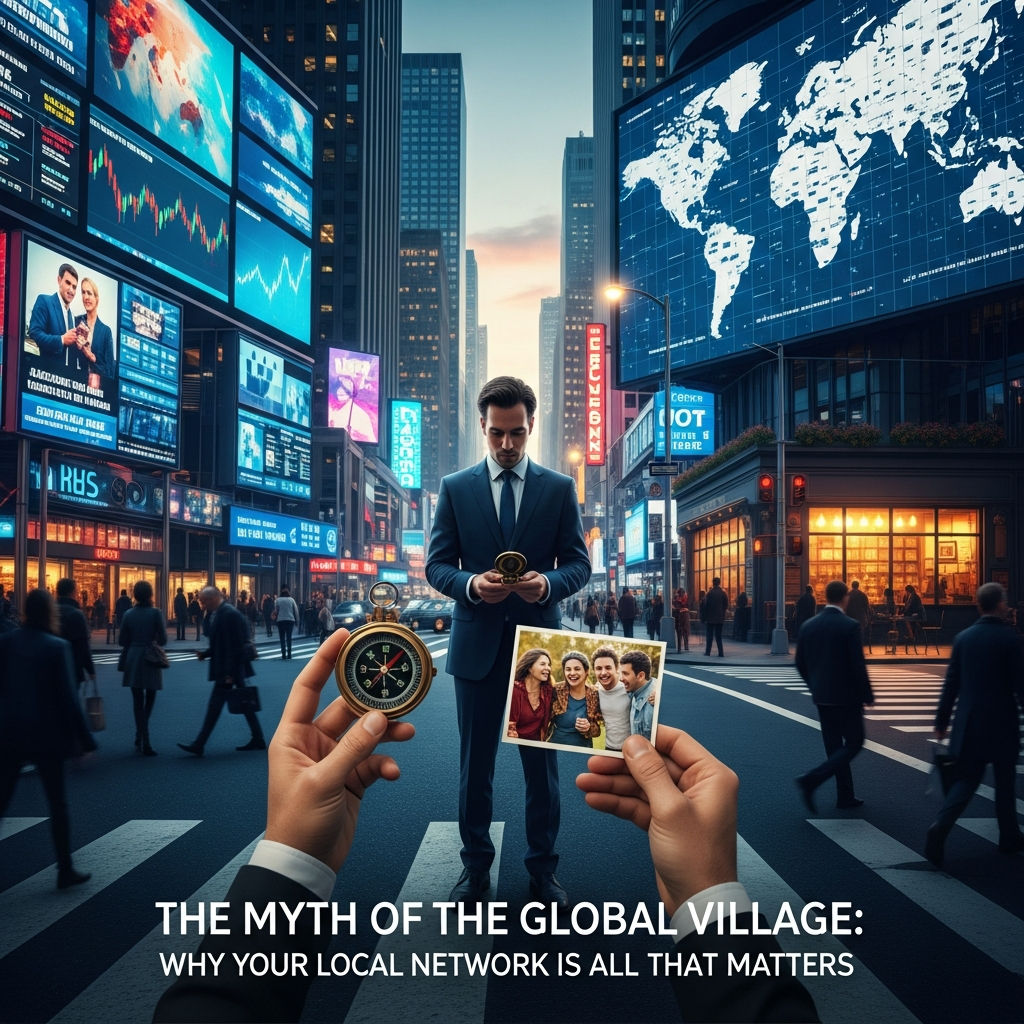
Hyper-localization is not about isolationism; it is about building a foundation. If your career or business is entirely dependent on an algorithm controlled by a company 3,000 miles away, you are vulnerable. If your network is rooted in your physical community, you have a safety net that no software update can take away.
The Psychological Cost of Global Comparison
One of the most damaging aspects of the Global Village myth is the “comparison trap.” When your “village” is the entire world via Instagram or LinkedIn, you aren’t comparing your progress to your peers; you are comparing your “behind-the-scenes” to the “highlight reels” of the top 0.01% of the global population. This leads to burnout, impostor syndrome, and a permanent sense of inadequacy.
Shifting your focus back to a local network grounds you. It allows you to be a “big fish in a small pond,” which is significantly better for mental health and leadership development than being an anonymous plankton in a global ocean. Success becomes tangible when you can see the impact you have on the people and places around you.
How to Rebuild Your Local Network
If you have spent the last decade building a digital presence at the expense of your local one, it’s time to pivot. Building a local network requires intentionality, but the rewards are exponential. Here is how to start:
- Join (or Start) a Local Niche Group: Whether it’s a real estate meetup, a coding club, or a community garden, find people with shared interests in your zip code.
- Volunteer Locally: Nothing builds trust faster than working toward a common goal without a profit motive. Volunteer for local boards or charities.
- Prioritize Face-to-Face Meetings: If you have the choice between a 30-minute call and a 30-minute coffee, choose the coffee. The “cost” of the commute is actually an investment in the relationship.
- Support Local Small Businesses: Become a “regular” somewhere. The social capital gained from being known in your community is an underrated asset.
The Hybrid Future: Global Reach, Local Roots
None of this is to say that the internet is useless. The ideal strategy for the modern era is to have Global Reach and Local Roots. Use the internet to learn, to source inspiration, and to find rare information. But use your local network to execute, to build community, and to find security.
The Global Village is a concept; the local network is a reality. The people you can actually reach out and touch are the ones who will define your quality of life. In an increasingly digital and disconnected world, the most radical (and effective) thing you can do is look away from the screen and engage with the person standing next to you.
Conclusion
The myth of the Global Village promised us a world where everyone was our neighbor. Instead, it often left us with thousands of acquaintances and very few true allies. By refocusing on your local network, you reclaim your time, your mental health, and your economic agency. Don’t be fooled by the allure of “global” influence. In the end, the people who know your name—not just your username—are the ones who matter most.
“`