Using New Technologies to Address Food Waste in the Restaurant Industry |
By Daniel Khachab, co-founder and CEO of Choco -3.5.2024
In December of last year, I was fortunate to be able to attend COP28 – the United Nations conference on climate change – where I listened to climate scientists, business leaders, politicians, journalists and NGOs try to find solutions to the most urgent issue of our time: climate change. While energy dominated most of the conversation, I was heartened to hear more discussion around one of the most critical but overlooked elements of climate change: food waste. Our food system contributions 24% of all greenhouse gas emissions, second only to those from electricity. By comparison, transportation accounts for only 14% of greenhouse gas, and a large percentage of that transportation is used to move food.
The food waste problem is particularly pronounced in the restaurant industry, where nearly just 15% of unused food is recycled or donated, meaning that fully 85% is simply thrown away. This contributes to this staggering figure: 40% of all food produced worldwide goes to wastewhich means that nearly 10% of global greenhouse gasses could be cut overnight if we just changed our behavior and improved the global food supply chain.
The root causes of our dysfunctional supply chain
Our food system is the world’s most complicated jigsaw puzzle, connecting 540 million farms to 8 billion consumers. The average lunch in New York or LA, London or Shanghai might feature quinoa from Paraguay, avocado from Mexico, chickpeas from India, salmon from Scandinavia or beef from Argentina, all cooked with oil from Ukrainian sunflowers and salt from Nepal. These products take complex and inefficient routes, changing hands an average of nine times before they arrive in front of the consumer. The scale is mind-boggling: 500,000 different products from trillions of tons of harvests, all transported across continents. The whole thing is a fragmented maze, a disorganized Frankenstein, held together by millions of quick fixes and spot solutions.
The food supply chain is primarily a “push” market, where producers push supply without clear visibility into market demand. As a result, there is more supply than demand, and buyers use this superior negotiation position to dictate prices. This dynamic eradicates producers’ income and ability to invest in modern food production methods. This disconnect fuels the vicious cycle of overproduction and ultimately, waste.
It has led to an almost complete absence of accountability. Farmers sell to the harvest manager, the harvest manager sells to the broker, the broker to the restaurant owner and so on. Every actor pushes the product to its respective next step, and this is where their responsibility ends. If there’s no demand, the product gets wasted. No one is thinking about the food system as a system, and creating alignment across its various pieces. A significant portion of the sector continues to operate using traditional pen and paper methods, with a very low level of digitalization. This makes it hard for players to make data-driven decisions and makes it even harder to create transparency across the supply chain.
Creating a globally connected digital food system
To comprehensively address these challenges we need to create coherence and collaboration at each level, from farmers and buyers to wholesalers, distributors, brokers, restaurant owners and beyond. Every value-adding business within the food supply chain needs to embrace technology that facilitates waste reduction and cost efficiency through process automation. Transformative measures should extend from leveraging data and AI to revamping back-of-house operations for suppliers, including warehousing, inbound operations, and purchasing.
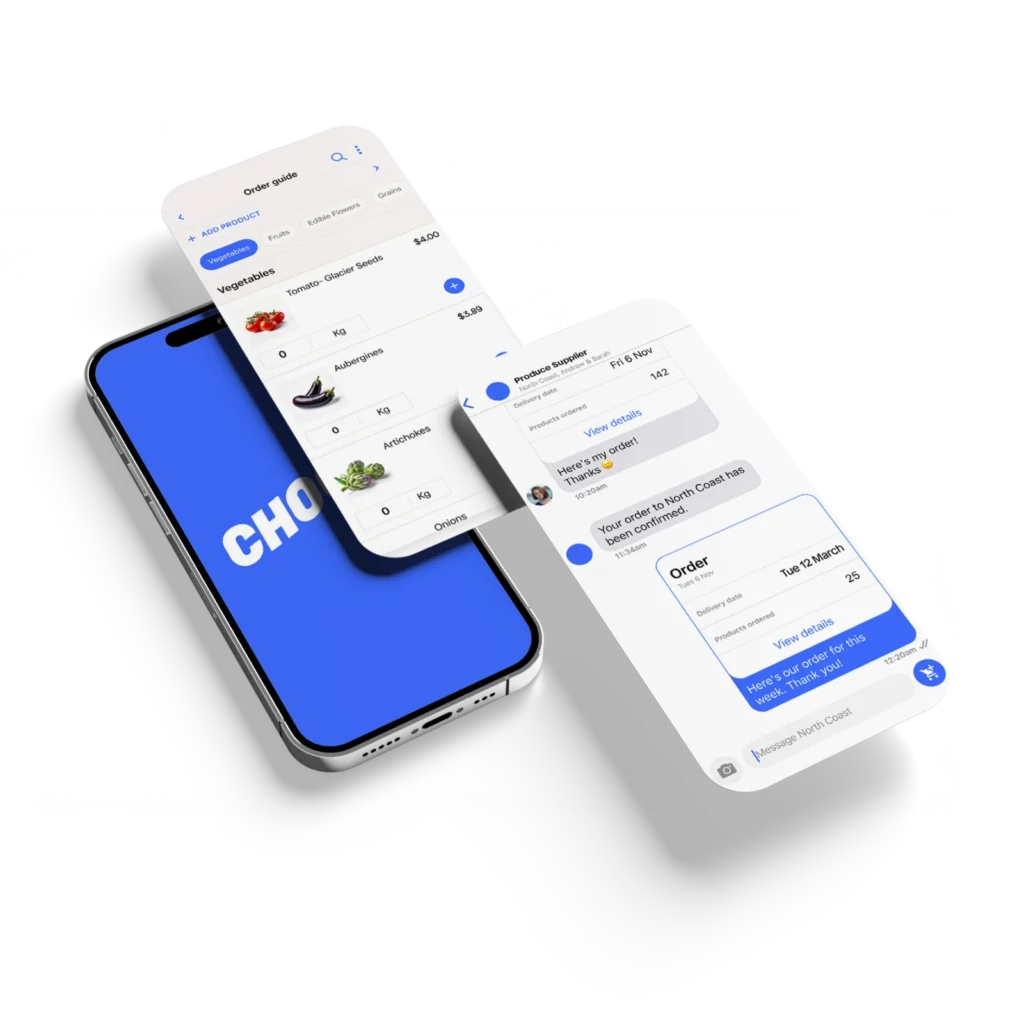 Happily, there have been a number of new technologies launched in recent years that can help restaurant owners be part of this digital approach to reducing food waste. Several companies offer automated inventory management systems which can help restaurants minimize food loss and waste through more accurate demand forecasting and real-time monitoring of stock levels. When it comes to time to place an order, tools like Choco enable restaurants to streamline the process and avoid the kinds of errors and duplicate orders that lead to waste.
Similarly, tableside and self-ordering technology can help restaurants avoid mistakes that lead to wasted food. New entrants can also help restaurants avoid sending surplus food to landfill. Copia uses an algorithm to match excess food from restaurants and other hospitality businesses with local non-profits and even arranges to have a third-party driver pick it up, while Too Good To Go has created a mobile app that allows consumers to buy leftover, expiring, or missing food at discount prices from local eateries.
Looking towards the future
I’m sure many will find this vision grandiose or even impossible. But the truth is that this is a problem that urgently needs to be solved – both because of the challenges we’re already facing as a result of climate change and also because our food system will have to feed a population of 10 billion by 2050. There is a limit to how much we can expand agricultural land, which means that reducing food waste is imperative.
There is also a strong economic incentive. Recent data found that a 20% reduction in food waste in the restaurant industry could save businesses up to $7 billion annually. And increasingly, there are reputational and competitive reasons for getting food waste under control. According to a 2022 survey of global consumers68% of people believe that restaurants should have processes in place to avoid waste and 43% would pay more for takeout food that is sustainable.
The message is clear. As business leaders, food suppliers, restaurant owners, chefs, or simply consumers, we are all part of the ecosystem and we all have a role to play in cutting down food waste. It’s not just an environmental crusade, it’s smart business as well as an urgent humanitarian need. We can turn this crisis into an opportunity for lasting change. Let’s make the future of food a sustainable one, starting today.

Daniel Khachab is the co-founder and CEO of Choco, an app solving food supply chain inefficiencies by simplifying how restaurants order from suppliers. After starting Ecommerce and SaaS companies from scratch and scaling them to market leadership internationally, Daniel decided to spend his life building Choco to solve one of the most pertinent problems in the world, food waste. Since 2018 Daniel has been building, inspiring and guiding Choco to solve that problem. Today, Choco’s team is just under 200 people strong and spans 2 continents. Prior to Choco, Daniel cut his teeth at Rocket Internet, where he quickly rose to the youngest CEO in their portfolio after scaling several international ventures. Daniel also served a year in the German Air Force. Since graduating from his alma mater, Maastricht University, where he earned a Bachelor of Science degree in International Business and Finance, Daniel has lectured on entrepreneurship and provided guidance for the alumni startup ecosystem, as well as recruiting many alumni to the ranks of Choco.
Are you an industry thought leader with a point of view on restaurant technology that you would like to share with our readers? If so, we invite you to review our editorial guidelines and submit your article for publication consideration.