Networking Events Are Just Bars for People Who Secretly Hate Their Jobs

“`html
Networking Events Are Just Bars for People Who Secretly Hate Their Jobs
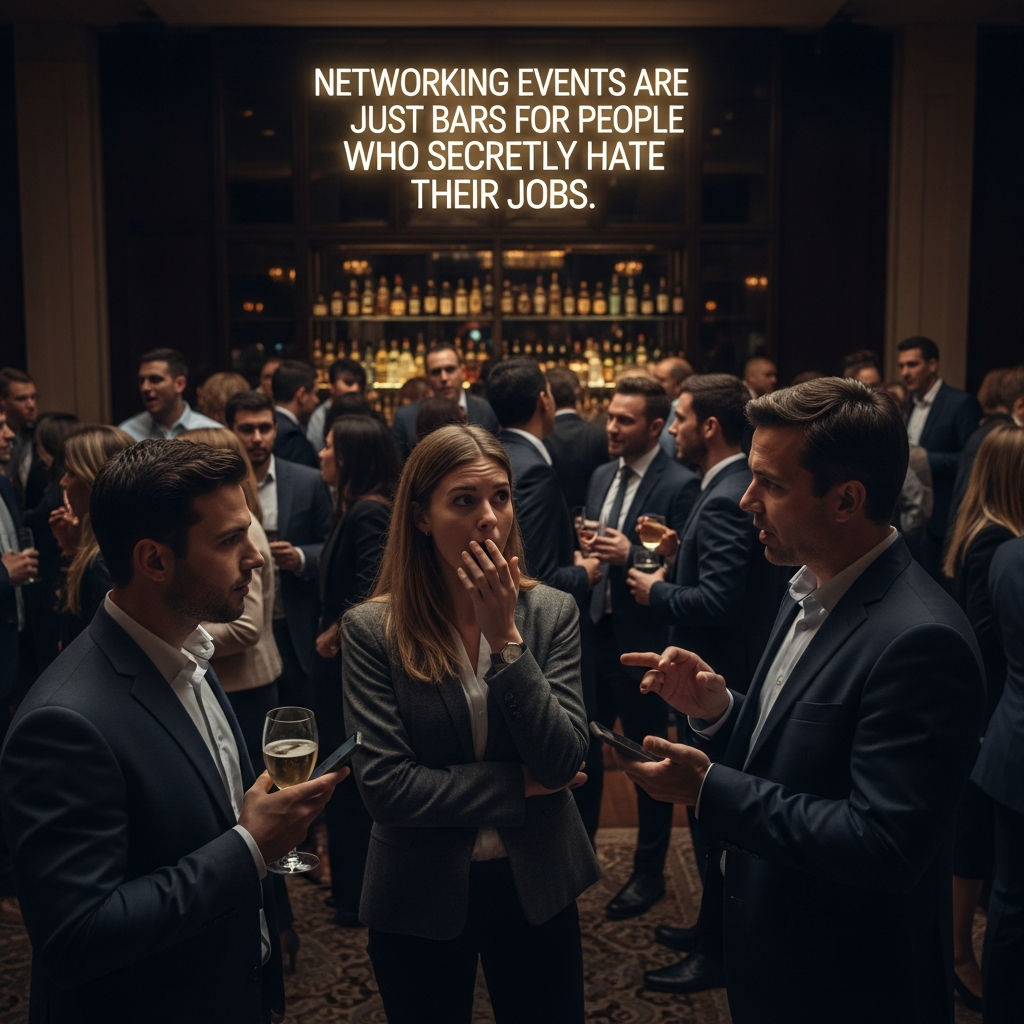
We’ve all been there: a dimly lit hotel ballroom or a sterile coworking space, clutching a lukewarm glass of Chardonnay in one hand and a stack of embossed cardstock in the other. The air is thick with the scent of slider burgers and desperation. On paper, it’s called a “professional mixer” or an “industry summit.” In reality, it’s a high-stakes support group. Let’s be honest: networking events are just bars for people who secretly—or not so secretly—hate their jobs.
In the modern corporate world, “networking” has become a buzzword synonymous with career growth and professional development. However, if you peel back the layers of “synergy” and “scalability,” you find a room full of people looking for a way out. These events function as a social safety valve for the disgruntled professional, providing the illusion of productivity while masking the underlying desire for a total career reset.
The Aesthetic of Professional Despair
A typical networking event mirrors the structure of a Friday night dive bar, just with more blazers and fewer jukeboxes. The goal is the same: to find a temporary escape from the reality of one’s daily existence. In a bar, you drink to forget your boss; at a networking event, you talk to strangers in the hopes that one of them will *become* your new boss.
The “happy hour” aspect of these events isn’t a perk; it’s a necessity. It is the social lubricant that allows people to perform the most unnatural of acts: summarizing their entire human identity into a thirty-second elevator pitch. Without the open bar, most networking events would collapse under the weight of their own awkwardness within twenty minutes.
The “What Do You Do?” Trap
The standard opening gambit at any networking event is the dreaded question: “So, what do you do?” For someone who loves their career, this is an invitation to share a passion. But for the vast majority of attendees, it’s a prompt to recite a rehearsed script that validates their paycheck while hiding their dissatisfaction.
- The Script: “I’m a Senior Associate in Logistics Optimization.”
- The Subtext: “I move spreadsheets around in a windowless office and cry in the breakroom on Tuesdays.”
By asking “what do you do,” we aren’t seeking to understand a person’s soul; we are checking their “trade value.” It’s the professional equivalent of checking someone’s relationship status at a singles bar. We are looking for a match that can facilitate our escape from our current professional purgatory.
The Secret Language of the Unhappy
If you listen closely to the chatter at these events, you’ll hear a specific dialect. It’s a coded language used by people who are tired of the grind but aren’t quite ready to quit without a backup plan. Understanding this “corporate-speak” is essential to navigating the room.
When someone says they are “exploring new horizons” or “open to a fresh challenge,” what they really mean is that their current manager is a micromanager who thinks “pizza parties” compensate for a lack of cost-of-living raises. Professional networking is often less about finding “opportunity” and more about finding a “rescue mission.”
Networking as a Coping Mechanism
For many, attending these events is a way to feel proactive about a job they hate without actually doing the hard work of soul-searching. It’s “productive procrastination.” Instead of updating their resume or learning a new skill, they go to a mixer. It feels like work, it looks like work, and it leaves you just as tired as work—but it doesn’t change the fundamental reality of a stagnant career.
Why Happy People Don’t Network (Like This)
Have you ever noticed who is *missing* from the local “Young Professionals Mixer”? Usually, it’s the people who are genuinely killing it in their fields. People who are obsessed with their craft, respected in their industry, and fairly compensated don’t usually spend their Wednesday nights hunting for business cards in a Marriott lobby.
Truly successful networking often happens organically through collaboration, shared projects, and genuine intellectual curiosity. It doesn’t require a name tag that says “Hello, My Name Is [Searching for a Way Out].” When you love what you do, your work acts as your business card. You don’t need the bar-like atmosphere of a mixer because you aren’t looking for a distraction from your professional life; you’re living it.
The Alcohol Factor: Liquid Courage for the Corporate Soul
There is a reason why “Networking & Drinks” is the most common format for these gatherings. Alcohol lowers the barrier to entry for the “fake it till you make it” lifestyle. It allows the accountant who hates numbers to pretend he’s “passionate about fiscal integrity” for three hours.
However, this creates a feedback loop of insincerity. When everyone is slightly buzzed and performing a version of themselves they think others want to hire, no real connection is made. We are just a room full of avatars pitching to other avatars, all while hoping the bartender pours the next one a little stronger.
How to Break the Cycle of Transactional Networking
If you find yourself at a networking event feeling like you’re in a bar for the professionally miserable, it might be time to change your approach. You don’t have to participate in the charade. Here is how to make “professional networking” feel less like a cry for help:
- Stop Pitching, Start Connecting: Instead of leading with your job title, lead with a hobby or a recent project you actually enjoyed. If you can’t think of one, that’s your sign that the problem isn’t the networking event—it’s the job.
- Quality Over Quantity: Don’t try to collect fifty business cards. Aim to have one meaningful conversation with one person who shares your values, not just your industry.
- Audit Your Motivation: Ask yourself: “Am I here because I want to grow, or because I want to leave?” If it’s the latter, spend that time applying for specific roles rather than wandering a ballroom.
Conclusion: Finding Work You Don’t Need to Escape
The cynical truth is that as long as people are unhappy in their careers, the “networking mixer” will thrive. It serves as a beacon of hope for the underappreciated and the overworked. But we must recognize these events for what they are: a symptom of a workforce that is often disconnected from meaning.
Next time you find yourself at a professional event, look around. If the room feels like a bar where the only thing being sold is the promise of “something better,” take a moment to reflect on what you’re actually looking for. Career growth shouldn’t feel like a night of bad drinks and forced smiles. The best “network” you can build is one based on genuine competence and shared goals, not a shared desire to escape the 9-to-5 grind.
Networking events don’t have to be bars for the miserable. They can be hubs of innovation—but only if we stop treating business cards like lottery tickets and start treating the people holding them like human beings.
“`