Apple And Samsung Looking To Increase Manufacturing In India
Tech giants Apple and Samsung are interested in increasing electronics production in India, Minister of State for Electronics and IT Rajeev Chandrasekhar has said, according to a report by Bloomberg. This comes amid Apple’s recent big retail push in India, as it aims to shift from its production dependency on China.
The South Asian nation is seeking to expand its early success in smartphones to other product categories, Chandrasekhar was quoted as saying by Bloomberg TV. India is launching a $2 billion plan to give a push to the local output of laptops, servers, tablets and other electronics. Earlier his week, the Union Cabinet approved Production Linked Incentive Scheme (PLI), PLI Scheme 2.0 for IT hardware that is likely to give a push to domestic manufacturing of laptops, PCs and ultra-small devices.
Click here to read the full report.
Apple Restricts Use Of ChatGPT For Employees
Amid reports of Apple developing its own artificial technology (AI) tool, the iPhone maker has restricted the use of OpenAI-owned ChatGPT for several of its employees, the Wall Street Journal has reported, citing people familiar with the matter. The company’s decision comes amid concerns about employees leaking confidential data and AI platforms collecting sensitive information.
Click here to read the full story.
Twitter Blue Gets Two-Hour-Long Video Uploads
Twitter has introduced updates to its paid Twitter Blue plan, enabling subscribers to upload videos up to two hours in length, a significant increase from the previous 60-minute limit. Furthermore, the company has made changes to its Twitter Blue page, announcing that the video file size limit for paid users has been expanded from 2GB to 8GB. Previously, longer video uploads were only possible through the web interface, but now users can also upload longer videos through the iOS app. However, the maximum quality for uploads remains at 1080p.
Under the leadership of Elon Musk, Twitter has made efforts to support longer video uploads and enhance the video viewing experience.
Click here to read the full story.
Meta Shares Details On Its AI Chips For The First Time, Plans To Make Its Tools Open For All
Meta, the social networking giant formerly known as Facebook, has shared details on its internal silicon chip projects for the first time. The company showcased its custom computer chips designed to enhance artificial intelligence (AI) and video-processing capabilities during a recent virtual event discussing its AI technical infrastructure investments. The disclosure comes as Meta aims to improve efficiency through cost-cutting measures and layoffs.
CEO Mark Zuckerberg on Thursday shared details of Meta’s AI research labs, data centers, and training accelerators. Here’s what he posted on his Facebook feed:
Click here to read the full story.
Stay tuned to ABP Live for more gadgets and tech news.
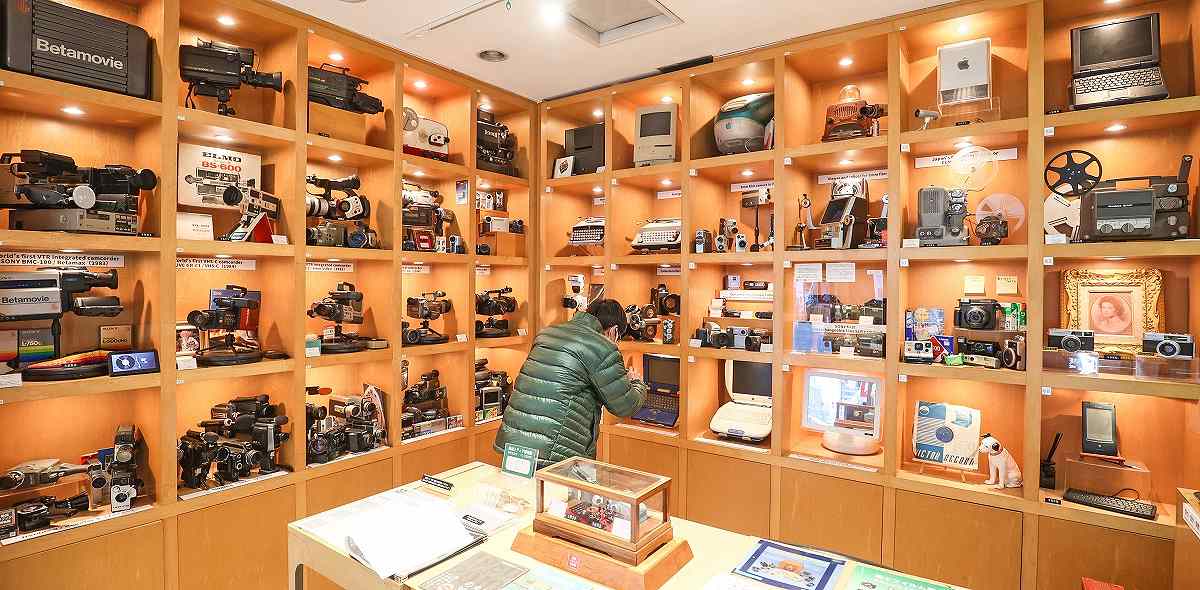
By Ryuzo Suzuki / Yomiuri Shimbun Senior Photographer A visitor takes a photo of an item at the Otemachi Extinct Media Museum in Chiyoda Ward, Tokyo, where extinct or fast-disappearing technology and gadgets line the walls. “If visitors’ photos and videos of items on display are posted on blogs or recorded by various media somewhere in the world, then such imagery may live on forever — that’s one of our ultimate goals,” said museum director Takuya Kawai.
By Ryuzo Suzuki / Yomiuri Shimbun Senior Photographer
11:46 JST, April 1, 2023
A private museum showcasing outdated media equipment and tools has opened in Chiyoda Ward, Tokyo.
Otemachi Extinct Media Museum, which began welcoming visitors in January, is the second after its sister facility, the Koenji Extinct Media Museum in Suginami Ward, Tokyo, opened last year.
By Ryuzo Suzuki / Yomiuri Shimbun Senior Photographer The exterior of the Otemachi Extinct Media Museum
The museums both boast impressive collections of outmoded telecommunication equipment and media, as well as items that are disappearing from mainstream usage due to the march of technological progress. Visitors can take photos of the items and even pick some devices up to get a “feel” for the ongoing transition from analog to digital-based lifestyles.
By Ryuzo Suzuki / Yomiuri Shimbun Senior Photographer Framed cassette tapes are seen at the Koenji Extinct Media Museum.
The museums were founded by Takuya Kawai, who operates motion picture studios and other facilities, and serves as director of both museums. Kawai, 53, said he is convinced that all types of media — except paper and stone — will eventually go extinct, driving him to collect such tools and equipment before they disappear from society.
By Ryuzo Suzuki / Yomiuri Shimbun Senior Photographer Old cell phones are seen at the Koenji Extinct Media Museum.
“I feel we should pay our respects to the history of each gadget’s development, which was often filled with trial and error,” Kawai said.
The museums now own over 1,000 items and this number continues to increase. About 80% of the gadgets were donated by people across the country who learned about the museums through social media and other means. During the prolonged stay-home period due to the COVID-19 pandemic, many donors are so seeking to get rid of unwanted items around them. The remaining 20% of the items were purchased by Kawai.
The devices at the Otemachi museum — located near Japan’s foremost business district — include old cameras, typewriters, computers, film rolls and floppy disks, among other articles.
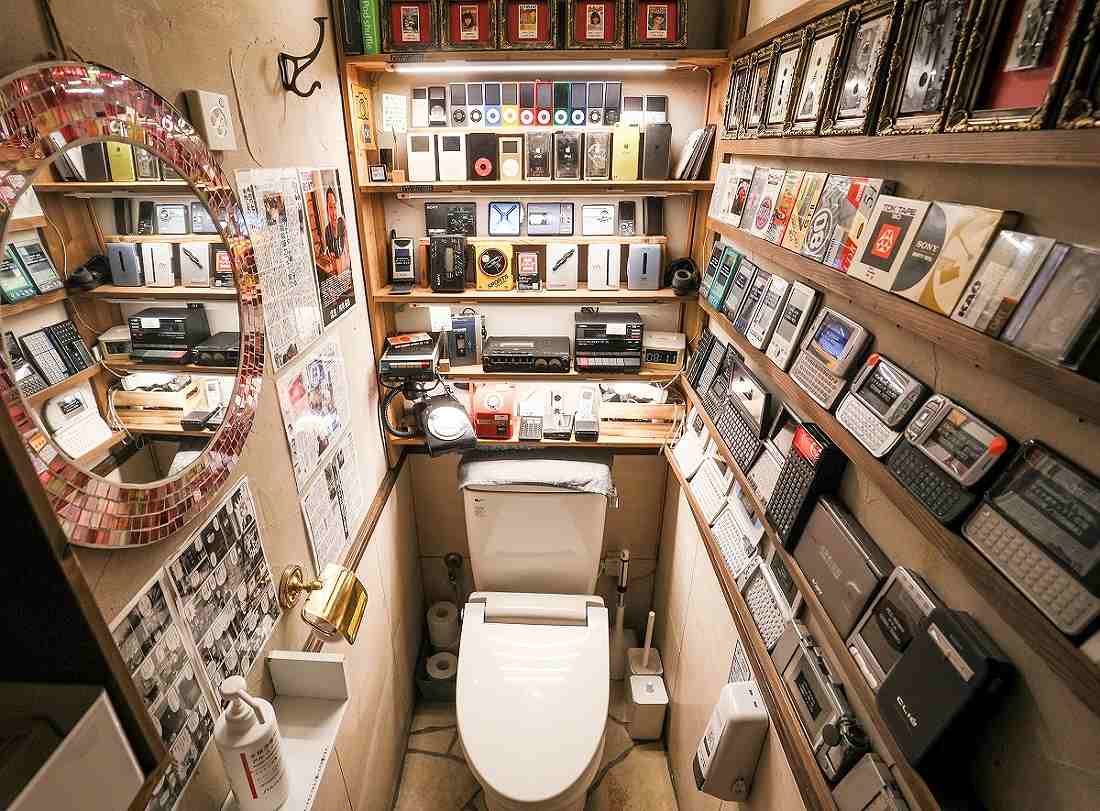
By Ryuzo Suzuki / Yomiuri Shimbun Senior Photographer Items are exhibited even in the restroom of the Koenji Extinct Media Museum in Suginami Ward, Tokyo.
The museum levies a ¥1,000 “cooperation fee” to help with the upkeep of the collection and is open weekdays from 11 am to 7 pm in principle.
The Koenji museum, meanwhile, is cramped with items, including flip phones, music players and cassette tapes. The flip phones on display set a trend, and around the year 2000, Japanese manufacturers were hard at work on the development of this style of phone. The facility only opens on Thursdays, from 7 pm to 11 pm in principle. Visitors are requested to pay a ¥500 cooperation fee and order at least one drink.
“I can pick up and touch items that I can usually only see on the internet,” said a systems engineer in his 40s who came to the Otemachi museum from Toshima Ward, Tokyo. “I feel so nostalgic and inspired.” The man spent about two hours at the facility.
Kawai noted: “Many manufacturers don’t keep copies of their goods, let alone retain the products’ online pages, due to corporate mergers or dissolutions. This can also happen for items that were once in fashion. It would be nice if our Extinct Media Museums became places that stir fond memories and affection in people.”
By Ryuzo Suzuki / Yomiuri Shimbun Senior Photographer The exterior of the Koenji Extinct Media Museum
Technologically speaking, the COVID-19 pandemic made Americans more connected than ever. From smart TVs and internet-enabled toys to game consoles, the average home today has 25 connected devices — more than twice as many as in 2019.
This profusion of technology comes at a cost: A gushing river of electronic waste. Gadgets are the fastest-growing category of trash, as well as the most polluting. Old devices are liable to leach toxic chemicals or catch fire. Recycling rates are dismal: Less than one-fifth of electronics is typically recycled every year.
“Globally, we’re generating e-waste that weighs as much as 100 blue whales a day, and 80% to 81% of that is not going to be recycled,” said Elizabeth Chamberlain, director of sustainability at iFixit, a community of repair enthusiasts.
Faced with this crisis, some major technology companies have taken steps to reduce the environmental impact of their products. After years of effectively encouraging planned obsolescence, Apple, Samsung and Google are letting customers fix some of their products, prolonging their lifespan. Critics say that’s not enough, pushing companies to do more and for government regulators to hold their feet to the fire.
As consumers recognize Earth Day on Friday, they can take steps to reduce the impact of their tech — and save money to boot. Here’s what environmental advocates suggest for making the most of your devices.
Keep your device longer
In looking at new devices, the first question should be whether to buy one at all. If you can avoid getting a new smartphone or laptop, either by repairing an older model or installing a few upgrades to get another year of use out of an existing gadget, do so, experts advise.
“The vast majority of a device’s carbon footprint comes from the manufacturing process,” Chamberlain said.
Americans buy about 161 million new phones every year, according to a recent study from US PIRG. If everyone kept a smartphone for an additional year instead of upgrading, it would reduce emissions as much as taking 636,000 cars off the road.
One major reason people replace their phones is to get more battery life. Replacing an older phone’s battery is no longer as easy as it used to be, but it’s still a way to extend the life of your device — and costs much less than buying a new one.
For example, iFixit sells an iPhone 12 battery replacement kit for $50, a repair the site rates as moderately difficult. Independent repair stores can sometimes replace device batteries, too.
Inside the company finding ways to solve our most difficult recycling problems
06:17
When purchasing a device, consider longevity
When buying a new gadget, research how easy it is to upgrade or repair — that could have a big effect on how long you keep it. iFixit grades smartphones, laptops and tablets based on how easy they are to repair, and provides crowdsourced manuals for many devices.
Note that some of those ratings could change soon now that some big tech companies are vowing to make it easier for people to get their products repaired. Apple has said consumers will be able to buy parts to do common repairs for the iPhone 12 and 13. Samsung in March announced a repair program for some Galaxy phones, and Google this month did the same for its Pixel phones. All are set to launch sometime this year.
Beware devices that use a lot of glue to hold components together instead of screws or snaps — that’s a sign that fixing it could be challenging.
Consumers can also seek out modular equipment, which is designed to be easy to take apart and customize. For example, the Framework laptop is a modular computer while the Fairphone aims to be a sustainable smartphone.
Beware of cheap TVs
Flat-screen TVs are particularly problematic since they’re often large and not built to last.
“We see so many flat-panel TVs that are depressing,” said Amanda LaGrange, CEO of Tech Dump, a nonprofit in Minnesota’s Twin Cities that refurbishes and recycles e-waste.
“Often people are buying them on a Black Friday, say, where some manufacturers, not all, are reducing the quality of the components. That’s how they can make it cheaper.”
To steer clear of the cheapest options, LaGrange suggests that consumers check the model number of the TV they want. “See if it’s sold at any other time of year. And if it’s not, it’s probably cheaper and then you can’t afford to repair that item.”
Buy refurbished tech
Tech Dump’s twin organization, Tech Discounts, refurbishes used latest gadget models and sells them at a discount. Many non-profits and online marketplaces do the same.
Consumers shouldn’t shy away from using technology because they assume it won’t perform as well, LaGrange said. Reputable retailers will do rigorous testing on refurbished goods, and many will sell items with return policies and warranties comparable to that of new gadgets.
“Once someone buys a refurbished electronic, people are much more likely to do it again. It’s like buying a used pair of jeans for the first time,” she said. “People think, ‘Why was I throwing money away?'”
Avoid the “pile of denial”
When it’s time to dispose of old electronics, give them a second life by passing them along to a friend or donating them to a recycling or refurbishing center. Many of these centers offer a financial bonus by letting someone write off the value of their donation.
But they should do it fast, instead of letting old technology pile up, counsels LaGrange. She refers to the “pile of denial,” where non-working electronics collect in a basement or garage for years. By the time someone donates them, they’re often too old to be refurbished and can only be tossed around.
“If you brought in your iPhone X that’s sitting in a drawer now, it could easily be refurbished,” she said. “If you wait six more years, it’s not so easy.”
“Repair Cafe” hopes to make treasure out of old trash
01:56
Support the “right to repair”
Despite a growing national movement around ensuring that consumers can repair their devices — an issue that is overwhelmingly popular and that has bipartisan support in Congress — no state has yet codified that right into law.
That needs to change to cut down on e-waste, said Nathan Proctor, head of the Right to Repair campaign at the Public Interest Research Group. “In terms of winning the argument, winning the public, we’re in a really strong position” he said. “In terms of actually fixing things, we’re just getting started.”
Currently, nine states are considering bills strengthening consumers’ right to repair. In addition, three bills have been introduced in Congress that would ease repair rights for cars, electronics and tractors.
Pressure from the Biden administration, which has pushed for consumers’ rights to repair, is a major reason that tech companies have softened their anti-repair stance, in Proctor’s view. But making that change permanent requires putting new laws on the books.
“These companies, their job is to make money. And it’s our job as citizens of this country to make sure they do it without hurting consumers and hurting the planet,” Proctor said.
iPhone Maker Foxconn Buys Land Near Bengaluru Airport
Foxconn, the biggest supplier and maker of Apple iPhone parts, has bought 300 acres of land in Bengaluru, months after signing an MoU with the Karnataka government to invest in the state. In filings with the London Stock Exchange (LSE), Hon Hai Precision Industry informed that its subsidiary Foxconn Hon Hai Technology India Mega Development on May 9 purchased land for approximately Rs 300 crore ($37 million) in the Bengaluru rural district of Karnataka, says a report by Moneycontrol. The land is located in Devanahalli, which is situated near the Kempegowda International Airport on the outskirts of Bengaluru. The move comes as the Taiwanese electronics manufacturer looks to diversify production away from China.
Click here to read the full story.
Poco F5 Launched In India Today
Handset maker Poco on Tuesday launched its much-anticipated Poco F5 smartphone in India and its price starts at Rs 29,999, which makes it a mid-range Android smartphone. The company also launched Poco F5 Pro 5G smartphone in select global markets on May 9. The vanilla Poco F5 is said to be a rebrand of the Redmi Note 12 Turbo. At this price point, the device competes with the likes of the Iqoo Neo 7 and Xiaomi Redmi Note 12 Pro Plus 5G. The Poco F5 5G is also available in another storage model for Rs 33,999 for 12GB RAM/256GB storage. There is an introductory offer under which the base model will be available for Rs 26,999 while the 12GB RAM model will be available for Rs 30,999. The Poco F5 5G comes with a one-year warranty in the country. The device will go on sale on e-commerce site Flipkart on May 16 in three colors: Carbon Black, Electric Blue and Snowstorm White.
Click here to read the full story.
MWC Organizer GSMA Slapped With €200,000 GDPR Fine
GSMA or the GSM Association, which is a non-profit industry organization that represents the interests of mobile network operators globally, has been slapped with a GDPR fine of €200,000 (~$224k) by Spain’s data protection watchdog for breaching privacy rules during Mobile World Congress (MWC) 2021 edition, media reports say.
GSMA, the organizer of MWC has been analyzed over a breach finding that relates to biometric data collection by the body on show attendees, including for a facial recognition system it implemented (called BREEZZ), which offered attendees the option of using automated identify verification to enter the venue in person rather than manually showing their ID documentation to staff, says a report by TechCrunch.
Click here to read the full story.
Twitter Will Archive Inactive Accounts
In a recent tweet, Twitter CEO Elon Musk revealed that the microblogging platform will take measures to address inactive accounts that have remained dormant for an extended period of time. The company will archive such accounts. Musk emphasized the importance of freeing up abandoned handles and announced that these inactive accounts would be removed from the platform. However, specific details regarding the timing of this process were not provided by Musk. At present, it remains unclear how users will be able to access these archived accounts, if at all. Twitter has not disclosed any information on this matter, leaving users in anticipation of further updates.
Click here to read the full story.
LinkedIn Lays Off 716 Employees, Shuts China App
LinkedIn, a Microsoft-owned company, has laid off 716 employees, as the company makes changes to its Global Business Organization (GBO), along with shutting down its InCareer app in China, reported by IANS. The company’s CEO Ryan Roslansky said in an email to employees that the move was aimed at streamlining the company’s operations. According to the report, Roslansky admitted that while the platform is making meaningful progress creating economic opportunities for its members and customers and experiencing record engagement on the platform, “we’re also seeing shifts in customer behavior and slower revenue growth”.
Click here to read the full story.
Stay tuned to ABP Live for all the top tech and gadgets news of the day.
Have you ever given any thought to what the word ‘smart’ truly means? At its most basic, it denotes someone who is clever, quick-witted, or very intelligent. But what about when it comes to a smart device? The dictionary (or Alexa, if we’re being honest) would say a smart device is one that’s programmed to be capable of some type of independent action. The keywords there are “some type.” That’s the trouble with smart devices, gadgets, and appliances: “smart” isn’t a universally understood or regulated feature.
Too often, manufacturers, in a bid to sell more gadgets, tack on the word smart in front of any old device. Today’s savvy consumer asks what exactly that means. Is it a clever feature? Wi-Fi connectedness? A companion app? All of the above? Or does something as simple as adding an LED touchscreen to an appliance make it smart?
Image used with permission by copyright holder
What is ‘smart’?
A ‘smart’ device can mean everything depending on the manufacturer. It can be a TV that has Wi-Fi or a smart speaker that can listen and respond to your queries. It can even be a gadget with a companion app. But what kind of smarts are you really getting, and is the technology useful and effective?
Smart ovens are a relatively new concept when it comes to the smart kitchen arena, but even in this small tech space, your options vary wildly. Some use curated food deliveries plus QR codes the oven (or a companion app) will scan. Once the code is scanned, the smart oven takes care of setting the temperature, adjusting the cooking time, and notifying you when the meal is ready. Others use store-bought food alongside an app to recommend recipes or cooking programs that promise to cook food perfectly, but you still have to use your head.
Smart but not smart
What about when it comes to smart kitchen gadgets in particular? Let’s take the example of a smart toaster. In the last few years there have been two significant launches of so-called smart toasters: the Revolution Instaglo and, more recently, the Tineco Toasty One.
These toasters are marvels of design and beauty and boast bright touch screens and toasting technology that promises crispy carb perfection. In fact, these are regular toasters with the addition of an LED touchscreen display. That’s it. No Wi-Fi, no “Hey Google, hit me with some toast,” and no tiny robotic arms that can retrieve sliced bread, grill it to perfection, then butter it for you. So while the addition of a glowing screen is nice and may allow you a few more options than a dial numbered one through six, in my book, this doesn’t truly constitute genuine smarts.
They’re also much more expensive than their “non-smart” counterparts — and while they might look fancy, they’re still just a toaster. In other words, most smart toasters aren’t worth your time or money.
Tineco
Smart kitchen appliances aren’t smart in the same way that an Amazon Echo smart speaker with a screen is truly smart. An Echo is connected to the web and can listen for you and respond appropriately. It can manage your schedule, turn on lights and adjust a thermostat, and even order supplies from Amazon for delivery.
However, even internet connectivity is no guarantee of a better gadget. Is, for example, a smart TV that allows streaming truly any more valuable than simply plugging in an external streaming TV dongle?
Some gadgets even put ‘smart’ in the name without ever actually adding intelligence, automation, or connectivity. One example is the Click and Grow Smart Garden, which is a great indoor winter garden for growing herbs and lettuce but it has no Wi-Fi, no connection, and no automated watering. It does, however, have an app that will send you push notifications reminding you to refill your water every month. So where is the ‘smart’ in that?
Image used with permission by copyright holder
NutriBullet made the Balance Blender which has a Bluetooth connection to a companion app. The app supplies recipes and works with a built-in scale to help you weigh ingredients in the recipe accurately. Pretty smart. There’s a smart toothbrush that will use your phone’s camera to watch you brush your teeth and give you a full report. Alexa-enabled coffee makers also already exist and allow you to call for your morning java from the comfort of the covers.
But there’s another consideration about these smart appliances: do we need that much help with basic tasks?
It’s possible to brush one’s teeth in two minutes without an app and without connecting to Wi-Fi, and while a camera-based brushing assessment might be nice for a check-in once in a while, it’s not the type of technology you’re looking for. going to want to use twice each day since it adds time and additional steps. Same deal with the Bluetooth blender; it might be helpful to have the built-in weight display scale on your smartphone the first time you make a recipe, but will you really need it after that? And while a digital touch screen is fun to watch while you’re waiting for toast, is it worth the literally hundreds of additional dollars you’ll spend?
As it stands, most smart kitchen appliances simply aren’t “smart” enough to recommend. Touchscreens and smartphone apps are great, but do they really make your life significantly easier?
A robot vacuum can save you hours of time every week. A video doorbell helps keep your home secure. Smart locks offer flexibility for large families. These smart gadgets bring massive improvements to your life and justify their price tags. But is a $300 toaster with a touchscreen really that much better than your $30 toaster from five years ago?
More and more kitchen gadgets are adding smart to the name. Don’t blindly buy the hype. It’s up to us as consumers to understand exactly what we’re really getting and decide if it’s truly worth it. And until kitchen appliances start to introduce “smart” features that actually make your life easier, there’s not a whole lot to get excited about.
If you couldn’t tell, we’re unabashedly nerdy about tech here at Engadget. While our jobs revolve around testing and reviewing gadgets and reporting on technological breakthroughs and social media controversies, our staff is composed of people who genuinely love technology and everything that goes into making cool gadgets. If you have someone in your life who shares the same passion, it might be difficult to find a piece of tech that you think they’d appreciate (and one they don’t already own). Here, we’ve gathered some of our favorite gear that we’ve tested and used and think would make great gifts for the tech nerd in your life — and no, they all don’t cost a fortune.
Marshall Emberton II
Will Lipman Photography for Engadget
Any tech lover will appreciate the Marshall Emberton II speaker, and not just for its good looks. The latest version of the compact, rectangular speaker has 10-watt full-range drivers and passive radiators that help deliver the balanced sound that’s signature to the brand. Its 360-degree sound makes it a great choice for small get-togethers as well as tiny desk concerts while they’re working from home. Marshall improved the battery life on this model too, bumping it up from 20 hours to 30, and it has a more durable IP67 rating as well. And if your giftee ever decides they want to expand their sound system, Stacked Mode will let them pair multiple Emberton II speakers together. – Valentina Palladino, Senior Commerce Editor
$120 at Amazon
Amazon Echo Show 15
Will Lipman Photography for Engadget
If the tech geek in your life is into smart home automation, this gift might help bring it all together. The Echo Show 15 serves at least five different purposes: a display for video doorbell feeds, smart home control deck, widget-driven bulletin board, compact smart TV and home for Alexa’s soon-to-be-chattier assistance. The 15-inch screen is big enough to accommodate all of the above and can be wall-mounted in portrait or landscape orientations. And, while it comes with a remote, it can also be operated via touchscreen or just by talking. — Amy Skorheim, Commerce Writer
$280 at Amazon
Sonos Ray
Photo by Nathan Ingraham / Engadget
Giving the tech-lover on your list a way to get better sound out of their TV will be a welcome treat. While soundbars can be unwieldy and expensive, the Sonos Ray is neither. The compact gadget earned a spot on our list of best soundbars thanks to its relatively small size, which will fit nicely into most living room setups. It will also provide a noticeable bump in audio quality, whether they’re watching action movies, suspenseful dramas or live sports. The Ray also supports AirPlay 2 and can be used to stream music, audiobooks and other content from various services even when the TV is off. And if your giftee decides to expand upon their audio system over time, the Ray will pair seamlessly with other Sonos gear. – VP
$279 at Sonos
DJI Mini 3
DJI
If you want to gift a true tech toy to the gadget lover in your life, you can’t go wrong with a drone. DJI’s Mini 3 is very similar to the Pro model in that it sits above it in the lineup, sans forward and rear obstacle detection and ActiveTrack. It also weighs only 249 grams, so most countries do not require users to have a special permit to fly it. The DJI Mini 3 can shoot 4K 30fps video and take 12-megapixel photos, and its camera can flip 90-degrees to offer vertical photos and video as well. DJI’s QuickShots are also supported here, which makes it easy to take short, social media-friendly videos without much human intervention — the drone does most of the work on its own. We recommend springing for the package that includes DJI’s RC controller; your giftee will thank you – it’s a lot easier to use than their smartphone. – VP
$609 at eBay
Audeze Maxwell
Audeze
The Audeze Maxwell is the best wireless gaming headset we’ve tested for those who spend lots of time gaming with friends online. First and foremost, it sounds great, with impactful but not overblown bass and a generally high level of detail that should keep your loved one enveloped in a multiplayer battle in Hello Infinite or a tense stealth scene in The Last of Us.. The detachable mic sounds clear and does a superb job of subduing background noise. It’s definitely on the bulky side, but the cushy design looks far less obnoxious than most gaming headsets. Battery life is good at roughly 80 hours, plus there are models for both PlayStation and Xbox (or PC). — Jeff Dunn, Senior Commerce Writer
$299 at Amazon
Anker Prime 20,000mAh Power Bank
Will Lipman Photography for Engadget
Chances are, the person who’s into all things tech already has a spare battery pack or two, but Anker’s Prime bank is a little different. First, the 20,000 mAh size is big enough and the 100W ports are powerful enough to juice up even a laptop. There’s a display that tells you how much charge the battery has left, as well as how much it’s pumping out per port. But the best part is the recharging base. Instead of the (admittedly minor) hassle of plugging the power bank in to recharge, just set it on the base and it’ll always be ready to go. Unfortunately, the base is a separate and not inexpensive purchase, but it makes for a haute portable charging experience. — US.
$130 at Amazon
Peak Design Tech Pouch
Engadget
There’s a good chance that, when your tech-loving companion travels, they bring along the gear that means the most to them. Peak Design’s Tech Pouch will give them a way to organize all of their small gadgets and keep everything neatly in one place. The origami-style pockets can accommodate things like phones, wireless chargers, power banks, adapters, cables and more. Plus the outside shell is water resistant. The bag can stand upright even when open, which will make it easier to find what they need in a pinch, and the exterior pocket has a passthrough opening that will allow them to connect to a power source and charge up items still inside the bag. The Tech Pouch is roomy without being too big or cumbersome, making it an easy gift for anyone who’s constantly on the go. – VP
$60 at Peak Design
Logitech G PowerPlay Wireless Charging Mouse Pad
Logitech
The Logitech PowerPlay is a mouse pad that wirelessly charges a mouse as you use it. It only works with a handful of Logitech mice (we recommend the G Pro Physically charging a mouse that much of a hassle, but once your loved one no longer has to worry about cables or charging, it may be hard for them to go back. The mat also comes in both cloth and hard plastic surfaces; the former is softer and quieter, while the latter is a little slicker for fast movements in games. — J.D
$100 at Amazon
Govee M1 RGBIC LED Light Strips
Govee
Smart lights are a great way to add personality to any room, and Govee’s M1 RGBIC smart light strip will make a great gift for any tech lover who wants to match their home’s vibe to their mood. This model has an upgraded chipset, higher brightness and richer color performance than previous Govee light strips, and the entire thing can be controlled via the company’s companion app. Your giftee can customize their lights by segment, giving each a different color if they wish, and control the whole thing with Alexa or Google Assistant commands. Govee’s app has an impressive number of preset light effects and customizations, but users can create and save their own to use whenever they want. They’re sure to get regular use, whether to set the mood for their next game stream, or on movie night. – VP
$70 at Amazon
Tidbyt
Tidbyt
The Tidbyt is a small LED light board that can display the time, weather, sports scores, calendar and transit alerts, news headlines or that floating DVD logo that never hits the corner of the screen, all in stylish chunky pixels. Its walnut hardwood case is about eight inches long and doesn’t include any mics or cameras. It’s a piece of nerdy decor that, at $199, is probably overpriced. But hey, this is a gift guide, and it looks nice on a bedside table or kitchen counter. — J.D
$199 at Tidbyt
Boox Page
Boox
When testing Boox ereaders for our guide, I didn’t get them at first; the library is just open domain stuff and the proprietary reader app doesn’t support rights-managed titles. When I realized that this was simply a compact tablet based on Android with a (rather crisp) E Ink screen, it finally made sense. It can run just about any app on the Google Play store; it can be a Kindle, a Kobo, a Libby library book reader and many things in between. The Page has a premium feel with a soft front light and snappy page turn buttons. Those buttons, and just about every other feature of the Page, are customizable and there are plenty of ways to tailor the device even further. In short, it’s an impressively built ereader that the tech-obsessed will get a lot of use out of, while giving their eyes a break from the bright LED screen. — US.
$250 at Boox
LEGO Nintendo Entertainment System
Engadget
Every person I know who’s deep into tech started their journey with LEGOs, video games or both. This delightfully retro and incredibly detailed TV and original NES LEGO set will warm the heart of anyone who’s ever held a controller in their hands. The finished set stands about ten inches tall and with 2,600+ pieces, it’ll take many hours to build. Afterwards, it’ll look excellent on a shelf and strike joy in everyone who sees it. If anyone I know is reading this, please make this my gift this year. — US.
$286 at Amazon
ASUS ROG Strix Scope II 96 Wireless Gaming Keyboard
Will Lipman Photography for Engadget
If you’re shopping for someone who spends most of the day typing and likes to unwind with a good game, the ASUS ROG Strix Scope II 96 Wireless should be a treat. Horrendous name aside, this is a premium wireless mechanical gaming keyboard, with a sturdy aluminum frame and crisp keys that are delightfully smooth to press and relatively quiet in action. Its 90-hour battery life (with RGB lighting on) is solid, it comes with a detachable wrist rest and it has a clever multi-function key that puts all its volume, media and backlighting controls in one spot. It should make any PC gamer’s work or play time more comfortable. — J.D
$160 at Amazon
XGIMI MoGo 2 Pro 1080P
XGIMI
Even the person who has everything may not have one of these yet. XGIMI’s MoGo 2 Pro is one of our recommended projectors because it’s small enough to fit in a backpack and delivers a detailed image that’s relatively accurate. There are HDMI, USB-A and USB-C ports, but it also supports Chromecast and has AndroidTV built-in. To play it outdoors, you’ll need either a long cord or a battery pack as this doesn’t have an internal one. But at under $600, it’s pretty affordable for a quality projector. — US
India’s cartograph satellite Cartosat-2 launched in 2007 successfully re-entered the Earth’s atmosphere over the Indian Ocean, said the Indian Space Research Organization (ISRO) on Friday.
“Cartosat-2, ISRO’s high-resolution imaging satellite, bid adieu with a descent into Earth’s atmosphere on February 14, 2024, as predicted. ISRO had lowered its orbit from 635 km to 380 km by early 2020,” the Indian space agency said.
“This strategic move minimizes space debris and underscores ISRO’s commitment to sustainable space exploration,” ISRO added.
Weighing 680 kg at launch, the Cartosat-2 was operated in a Sun-synchronous Polar orbit at an altitude of 635 km. Until 2019, it provided high-resolution imagery for urban planning.
Initially, the satellite was expected to take about 30 years to naturally de-orbit. However, ISRO opted to lower its perigee using leftover fuel to comply with international guidelines on space debris mitigation.
This involved reducing collision risks and ensuring safe end-of-life disposal, following recommendations from organizations such as the United Nations Committee on the Peaceful Uses of Outer Space (UN-COPOUS) and the Inter-Agency Space Debris Coordination Committee (IADC), ISRO said.
ISRO’s System for Safe and Sustainable Space Operations (IS4OM) team at ISRO Telemetry Tracking and Command Network (ISTRAC) predicted Cartosat-2’s atmospheric re-entry for February 14, 2024.
Electrical passivation was completed on February 14th, and tracking continued until re-entry.
The final telemetry frames confirmed successful passivation, with the satellite reaching about 130 km altitude. ISRO then tracked the satellite by its multi-object tracking radar at its rocket port in Sriharikota.
The final prediction placed Cartosat-2’s re-entry over the Indian Ocean at 3:48 pm IST on February 14.
Analysis indicated that all major spacecraft components would demise during atmospheric re-entry. Cartosat-2’s successful de-orbiting at its end-of-life represents a significant step for ISRO in ensuring the long-term sustainability of outer space activities.
The four astronauts who will be part of India’s first human space flight program, Gaganyaan, were trained at the Yuri Gagarin Cosmonaut Training Center in Russia, the same center where Rakesh Sharma underwent training. Rakesh Sharma was the first Indian to go into space in 1984.
Gagarin Cosmonaut Training Center (GCTC), at Star City, is about 30 kilometers north of Moscow. It was named for the first man in space, Yuri Gagarin.
The center offers high-tech training facilities, including integrated simulators. It also offers survival training for many possible landing situations, including mountains, woodlands, marshes, deserts, in the Arctic and on the sea.
Meanwhile, Prime Minister Narendra Modi announced on Tuesday the names of the four astronauts who will be in Gaganyaan, slated to be launched in 2024-25.
The four chosen Indian Air Force pilots are Group Captain Prashanth Nair, Group Captain Ajit Krishnan, Group Captain Angad Pratap, and Wing Commander Shubhanshu Shukla. The four astronauts were trained at the Yuri Gagarin Cosmonaut Training Center in Russia.
Prime Minister Narendra Modi, who is on a visit to Kerala, reviewed the progress of the Gaganyaan mission and bestowed ‘astronaut wings’ on the astronaut-designates at Vikram Sarabhai Space Centre.
The Gaganyaan mission is India’s first human space flight program, for which extensive preparations are underway at various ISRO centres.
“India’s success in the space sector is bearing the seeds of scientific temperament in the country’s young generation,” PM Modi said in his address at the Vikram Sarabhai Space Centre.
“As India is set to become the top-3 economy in the world, at the same time, the country’s Gaganyaan is also going to take our space sector to a new height,” the PM said.
As per ISRO, the Gaganyaan project envisages a demonstration of human spaceflight capability by launching a crew of three members into an orbit of 400 km for a three-day mission and bringing them back safely to earth, by landing in Indian sea waters.
The pre-requisites for the Gaganyaan mission include the development of many critical technologies, including a human-rated launch vehicle for carrying crew safely to space, a life support system to provide an Earth-like environment to crew in space, crew emergency escape provisions, and evolving crew management aspects for training, recovery, and rehabilitation of crew.
Various precursor missions are planned to demonstrate the technology readiness levels before carrying out the actual human space flight mission. These demonstrator missions include Integrated Air Drop Test (IADT), Pad Abort Test (PAT) and Test Vehicle (TV) flights. The safety and reliability of all systems will be proven in unmanned missions preceding manned missions.
LVM3 rocket the well-proven and reliable heavy lift launcher of ISRO, is identified as the launch vehicle for the Gaganyaan mission.
Human safety is of paramount importance in the Gaganyaan mission. In order to ensure the same, various new technologies, consisting of engineering systems and human-centric systems, are being developed and realized.
In 2023, in a stellar display of progress, India soared to new heights with the successful soft landing of Chandrayaan-3 on the South Pole of the Moon and the successful launch of Aditya-L1, India’s first solar mission.
These milestones not only secured India’s standing in the global space economy but also fueled the engines for the private space sector in India.
Among other feats, India now aims to set up ‘Bharatiya Antariksha Station’ by 2035, and send the first Indian to the Moon by 2040.