The Hidden Cost of Connection: Why Networking Is the Mortal Enemy of Deep, Meaningful Work

The Hidden Cost of Connection: Why Networking Is the Mortal Enemy of Deep, Meaningful Work
In the modern professional landscape, we are constantly told that “your network is your net worth.” We are encouraged to attend mixers, optimize our LinkedIn profiles, and engage in endless “coffee chats” to build social capital. However, a growing body of evidence suggests that this obsession with professional socializing is coming at a devastating cost: the ability to perform deep, meaningful work.
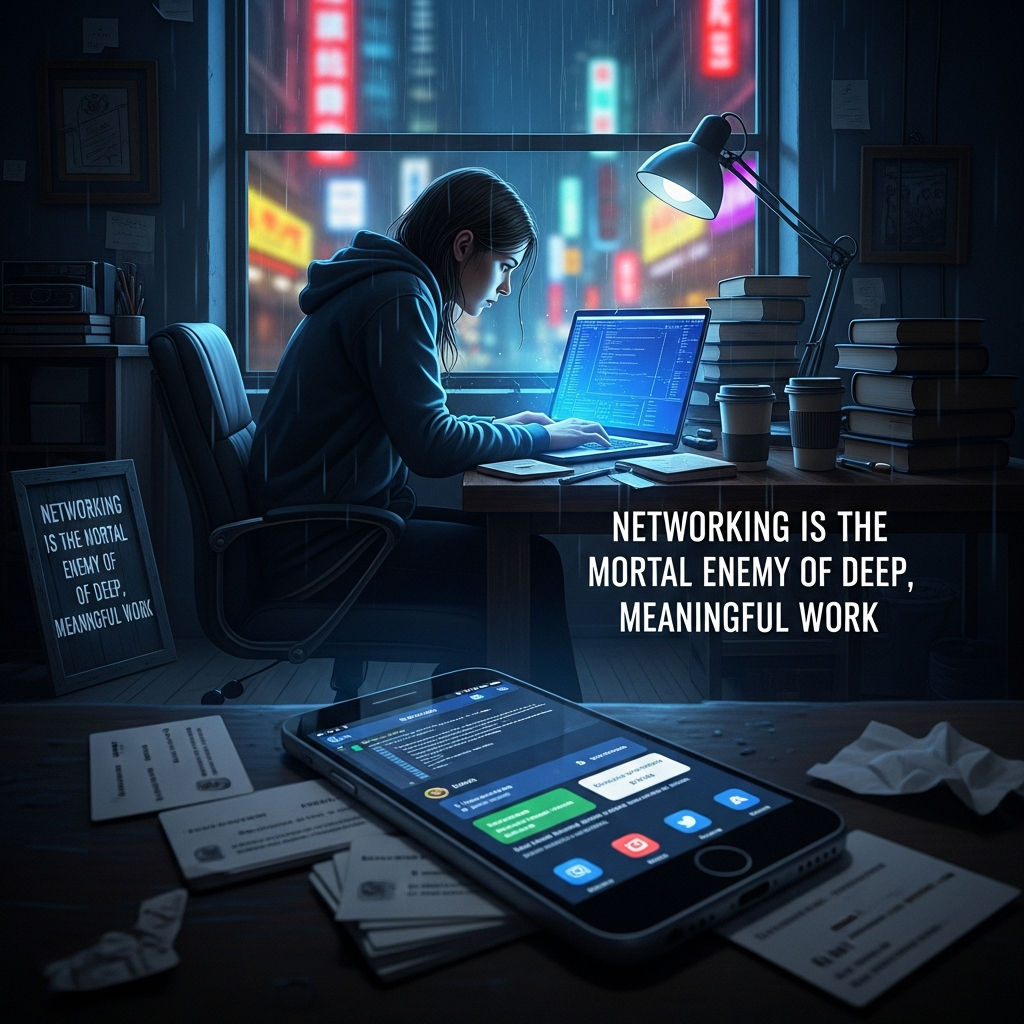
The cult of networking has created a paradox. While we are more connected than ever, the quality of our output is often declining. By prioritizing breadth of connection over depth of concentration, we are sacrificing the very skills that make us indispensable in an increasingly automated economy. To understand why networking has become the mortal enemy of deep work, we must examine the cognitive toll of constant connectivity and the myth of the “connected” professional.
The Cognitive Conflict: Deep Work vs. Shallow Networking
Deep work, a term coined by Georgetown professor Cal Newport, refers to professional activities performed in a state of distraction-free concentration that push your cognitive capabilities to their limit. These efforts create new value, improve your skill, and are hard to replicate. In contrast, networking is almost always “shallow work”—tasks that are cognitively undemanding and often performed while distracted.
The Danger of Context Switching
One of the primary reasons networking destroys deep work is the phenomenon of “attention residue.” Research shows that when you switch from one task to another, a portion of your attention remains stuck on the previous task. If you spend your morning responding to LinkedIn messages or jumping on “quick” introductory calls, your brain remains fragmented for hours afterward. You cannot simply flip a switch and enter a state of flow; the ghost of your social interactions haunts your cognitive processing power, making it impossible to solve complex problems or produce high-level creative output.
The Performative Trap
Networking often demands a level of performative presence. To be a “good networker,” you must be responsive, visible, and perpetually available. This requirement is diametrically opposed to the requirements of deep work, which demands isolation and unavailability. When you prioritize being “known,” you inevitably spend less time being “good.” The performative nature of networking encourages a surface-level engagement with one’s industry, where sounding smart in a comment thread becomes a substitute for actually doing the difficult work of mastering a craft.
The Opportunity Cost of Social Capital
Every hour spent at a networking event or browsing professional social media is an hour not spent in the “woodshed”—the metaphorical place where masters hone their craft. In the short term, networking feels productive because it provides immediate social validation. Deep work, however, is often lonely, frustrating, and offers no immediate feedback. This leads many professionals to choose the “low-hanging fruit” of social interaction over the “heavy lifting” of skill acquisition.
- The Expertise Gap: As you spend more time building a network, your actual expertise may stagnate. In a competitive market, a person with a massive network but mediocre skills is easily replaced. A person with world-class skills and a small network is a rare commodity.
- The Dilution of Focus: Meaningful work requires a singular focus on a specific objective. Networking introduces a multitude of competing priorities, “opportunities,” and distractions that pull you away from your primary goal.
- The False Sense of Accomplishment: Handing out twenty business cards feels like progress, but it rarely results in the creation of a tangible asset. It is a form of “productive procrastination.”
The Myth of the “Inspiration” Chat
We often justify networking by claiming we are looking for inspiration or “serendipity.” We tell ourselves that meeting a new person might lead to a breakthrough idea. However, breakthroughs rarely happen in a vacuum of conversation; they happen when a mind, already saturated with deep thought, encounters a new piece of information. Without the foundation of deep work, networking is just noise.
Relying on others for inspiration is a reactive strategy. Proactive professionals find inspiration through the rigorous interrogation of their own work and the study of their field. When networking becomes the primary source of your ideas, your work becomes derivative, reflecting the “groupthink” of your social circle rather than original, meaningful insight.
How to Reclaim Your Depth in a Hyper-Connected World
The goal is not to become a hermit, but to rebalance the scales. To produce work that actually matters, you must treat your attention as your most valuable resource and guard it fiercely. Here are strategies to protect your deep work from the encroachment of networking:
1. Adopt the “Results-First” Protocol
Instead of networking to find opportunities, focus on producing work that is so good it cannot be ignored. Exceptional work creates its own “gravity.” When you are the best at what you do, the right people will find you, and the nature of those connections will be far more meaningful than any “cold reach-out” could achieve.
2. Practice Selective Unavailability
Define specific “monk mode” hours where you are completely unreachable. Turn off notifications, close your browser tabs, and let the world wait. By becoming harder to reach, you increase the value of your time and force yourself to prioritize the work that requires your full cognitive capacity.
3. Shift from Networking to “Connecting via Craft”
Instead of generic networking, engage in “collaborative output.” Connect with others by working on a project together or seeking specific feedback on a difficult problem. This anchors the relationship in meaningful work rather than superficial small talk. This form of networking is an extension of deep work, not a distraction from it.
4. The 90/10 Rule
Allocate 90% of your professional energy to deep, concentrated work and only 10% to maintenance of your network. Most professionals have this ratio inverted. By flipping the script, you ensure that when you do step out to network, you have something of substance to talk about.
Conclusion: The Rarity of Depth
We live in an era where everyone is “connected,” but few are “concentrated.” Because deep work is becoming increasingly rare, it is also becoming increasingly valuable. The professionals who thrive in the future will not be the ones with the most LinkedIn connections, but the ones who can sit in a room alone and solve a hard problem.
Networking is not inherently evil, but it is a tool that must be handled with extreme caution. When allowed to run rampant, it becomes the mortal enemy of the focus required for greatness. If you want to leave a mark on your industry, stop worrying about who you know and start worrying about what you are capable of producing. Silence the noise, close the laptop, and get back to the work that matters.